


The Cost of Equity in Valuations for Public Companies, Startups, and More
The Cost of Equity in corporate finance represents the annualized rate of return that investors target when they buy a company’s Common Stock; to a company, it represents the cost of issuing additional Common Stock to operate its business, where the “cost” includes both dividends (cash cost) and the dilution from these issuances. The Cost of Equity is widely used in valuation and DCF analysis.
The Cost of Equity in Valuations for Public Companies, Startups, and More
Cost of Equity Definition: The Cost of Equity in corporate finance represents the annualized rate of return that investors target when they buy a company’s Common Stock; to a company, it represents the cost of issuing additional Common Stock to operate its business, where the “cost” includes both dividends (cash cost) and the dilution from these issuances. The Cost of Equity is widely used in valuation and DCF analysis.
The most common formula for calculating the Cost of Equity is as follows:

But there are other methods to calculate the Cost of Equity, including via the Dividend Yield and Dividend Growth for more mature companies with stable Dividend issuances:

The “Risk-Free Rate” is typically based on 10-year government bond yields denominated in the company’s currency (e.g., US Treasuries for U.S. companies or Eurobonds for European companies).
The “Equity Risk Premium” (ERP) represents the additional percentage the stock market is expected to return over this Risk-Free Rate over the long term (e.g., it’s 6% if the RFR is 4% and the stock market’s long-term average annualized return is 10%).
Professor Aswath Damodaran at NYU maintains the best free data set for ERP by country.
You normally pick the ERP based on the country in which the company is listed on the stock market or the country of its most significant operations.
Finally, the “Beta” component represents how risky this specific company is relative to the entire stock market.
If Beta is 1.0, when the stock market goes up 10%, this company’s stock price also increases by 10%.
If it’s 2.0, the company’s stock price increases by 20% (and falls by 20% if the overall market falls by 10%).
You can find Beta for public companies on services like Google/Yahoo Finance, FinViz, Bloomberg, and Capital IQ.
For example, if the current Risk-Free Rate is 4.0%, the Equity Risk Premium is 5.0%, and a company’s Beta is 1.2, its Cost of Equity = 4.0% + 5.0% * 1.2 = 10.0%.
It’s slightly riskier than the entire stock market, which is why the Cost of Equity is 10.0% rather than 9.0%.
The Cost of Equity is always higher than the Cost of Debt because the risk and potential returns are both higher, the investors are less senior, and Equity is not tax-advantaged.
The most common use case for the Cost of Equity is calculating WACC, or the Discount Rate in a DCF model based on Unlevered Free Cash Flow.
It is also used in a DCF based on Levered FCF, in the Dividend Discount Model, and even in Debt vs. Equity analysis and merger models when calculating EPS accretion/dilution.
Files & Resources:
- Cost of Equity – Excel Examples (XL)
- Cost of Equity and WACC Changes as the Capital Structure Changes (XL)
- Cost of Equity – Presentation Slides (PDF)
- Western Midstream Partners – 10-K Excerpts (PDF)
- Steel Dynamics – 10-K Excerpts (PDF)
Video Table of Contents:
- 0:00: Introduction
- 6:20: Part 1: Real-Life Examples (WES and STLD)
- 9:55: Part 2: Cost of Equity Based on Dividends and Net Income
- 12:44: Part 3: Startups, Speculative Companies, and Other Uses
- 14:31: Part 4: How Does the Cost of Equity Change When…
- 16:12: Recap and Summary
Interpreting the Cost of Equity: Why Does Stock “Cost” a Company Anything?
One common question we get is: “I understand how Dividends cost a company something, but how does an annualized increase in the stock price correspond to any cost? The company does not ‘pay’ for its stock price to go up.”
Great question!
Just like the Cost of Debt represents the “cost” of issuing additional Debt, the Cost of Equity represents the “cost” of issuing additional Common Stock.
When a company issues additional Common Stock, its existing shareholders get diluted, so they own a lower percentage afterward.
For example, let’s say that Vanguard owns 10% of Company A.
If Company A now issues a significant amount of Stock, and Vanguard does not buy any new shares, its ownership might fall to 8%.
It owns the same number of shares, but they represent a reduced percentage of the company.
If this company’s stock price is expected to increase by 12% next year, Vanguard will not receive all these gains since it now has a reduced percentage.
The existing investors “pay for” this stock issuance, and corporate valuation is always from the perspective of the company’s investors.

-
Become a financial modeling pro
158 videos, detailed written guides, Excel files, quizzes, and more
-
Complete 10+ detailed global case studies
These include both the theory and the practical applications
-
Prepare for your internship or full-time job
Gain the skills you need to “hit the ground running” on Day 1
What is a “Good” Cost of Equity? What Are the Normal Ranges?
In most cases, the Cost of Equity falls into one of three ranges:
- 5 – 10%: “Less risky” companies are in this range; examples might be utility companies, many REITs, and mature consumer staples companies.
- 10 – 15%: “Moderately risky” companies, such as technology, industrials, or transportation firms, might go here.
- Above 15%: These tend to be much riskier companies that are in “growth mode” (startups), in emerging/frontier markets, or in special situations such as distress or bankruptcy.
In a valuation, you normally know the rough range your company is in, and you attempt to narrow it down to something more precise:
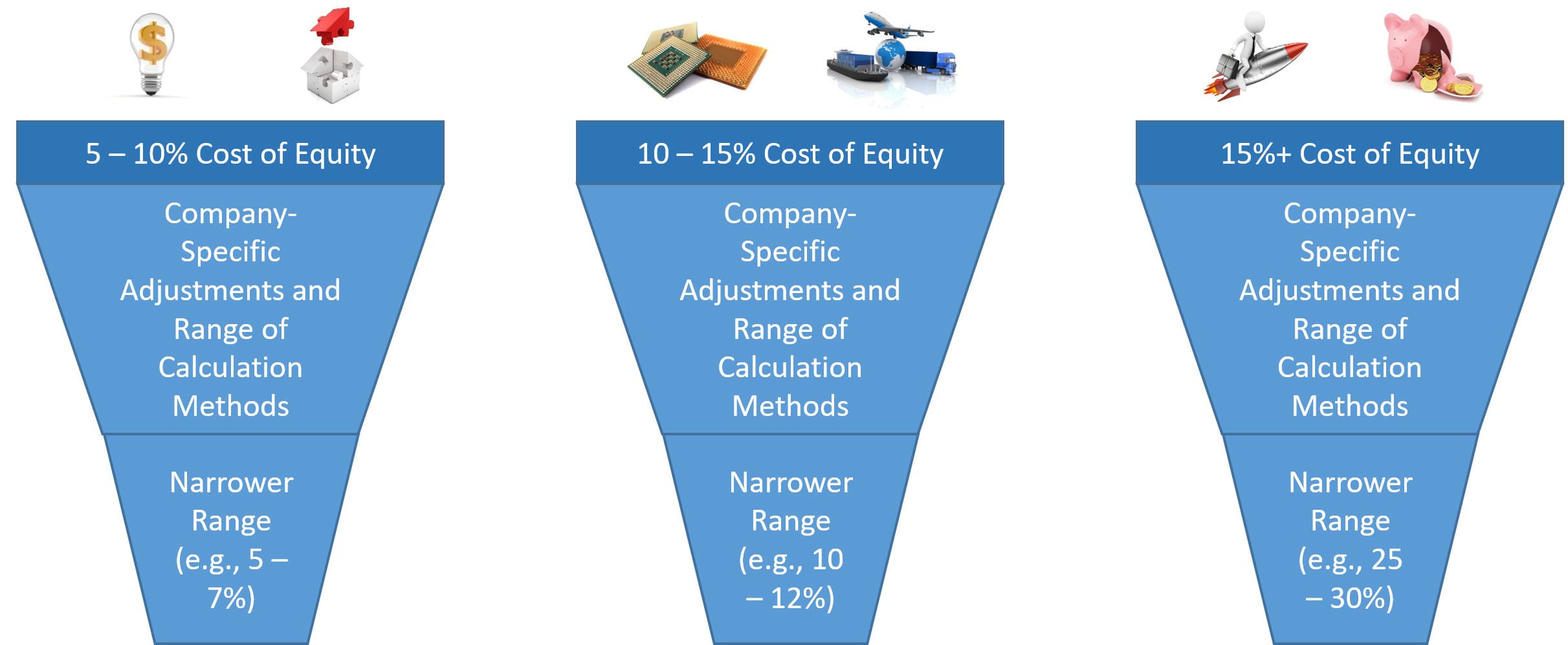
An appropriate spread is roughly 2 – 3%, so the Cost of Equity could be something like 5 – 7% or 8 – 10%, but a range like 5 – 10% is too wide.
So, if you get results like these from calculating the Cost of Equity via different methods:
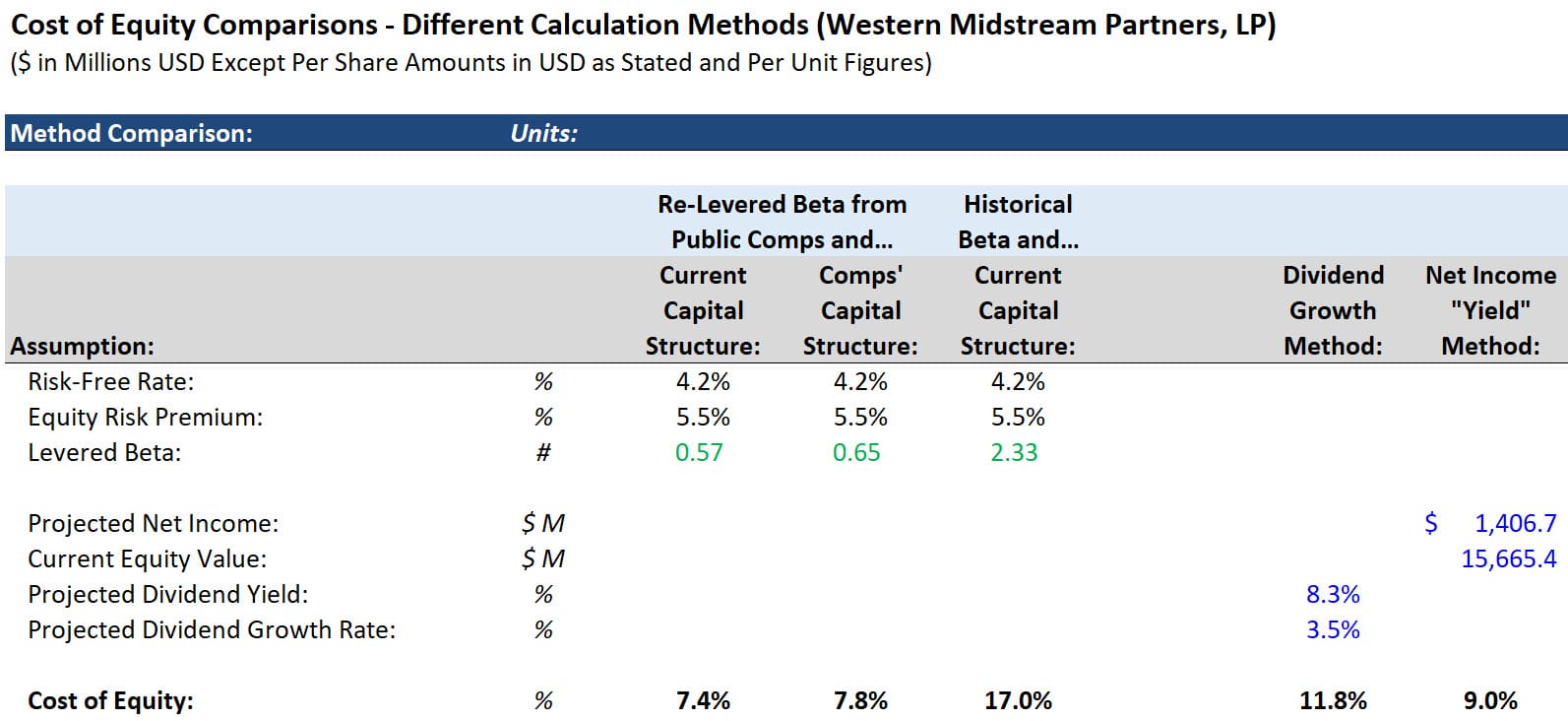
The appropriate range might be 8 – 10%.
You would not want to use a range of 7 – 17% because that’s far too wide to be useful, and the 17% here is an outlier that might be based on spotty data.
Calculating the Cost of Equity in Real Life: Examples for Western Midstream Partners and Steel Dynamics
When calculating the Cost of Equity in real life, the key challenges differ from those in the Cost of Debt calculation.
There, you may run into problems due to multiple tranches of Debt, a lack of disclosed market values, or companies with no Debt.
None of this is possible for the Cost of Equity because all companies have Equity, the market values are easy to determine, and there’s only a single class of common shares, so the challenges relate to conflicting information and calculation methods.
For Western Midstream Partners, a Midstream MLP company in the oil & gas industry, we calculate the Cost of Equity using three different methods, all of which employ the Risk-Free Rate + Equity Risk Premium * Levered Beta formula.
The difference lies in the Levered Beta calculation:
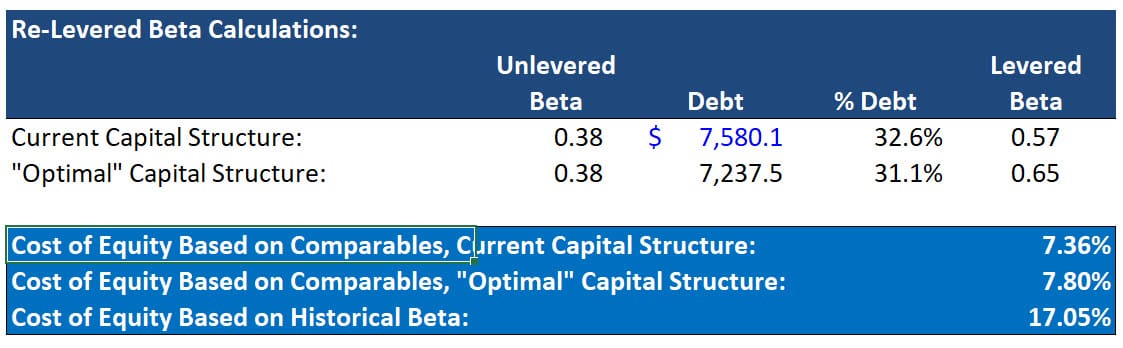
- Historical Levered Beta – With this method, we use the company’s historical Levered Beta from online sources (FinViz, Google Finance, etc.), which was a very high 2.33 at the time of this valuation (!!).
- Re-Levered Beta, Current Capital Structure – We “un-lever” Beta for each comparable public company, take the median, and “re-lever” it based on Western Midstream’s current capital structure
- Re-Levered Beta, Comps’ Capital Structure – Similar, but we re-lever the median Unlevered Beta based on the median Debt, Equity, and Preferred Stock percentages of the comparable companies.
For Western Midstream Partners, the latter two methods produce similar results, while the third one is completely different:
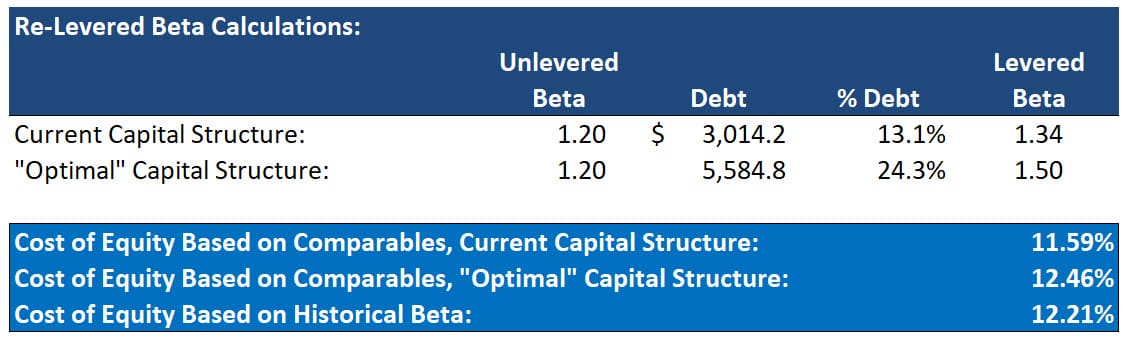
For Steel Dynamics, all three methods produce very similar results, so it’s easy to conclude that its Cost of Equity should be in the 11 – 13% range:
Calculating the Cost of Equity by Un-Levering and Re-Levering Beta
All companies have two types of risk: Risk from operating their core business and risk from leverage (Debt).
“Beta” on sites like Yahoo/Google Finance and FinViz includes both risks, so it is known as “Levered Beta.”
To separate the business risk, the first step is to find a set of comparable companies and look up the Debt, Equity, Preferred Stock, Beta, and Tax Rate figures for each one.
You can then “un-lever” Beta to separate the operational and financial risk with this formula:
Unlevered Beta = Levered Beta / (1 + Debt / Equity * (1 – Tax Rate) + Preferred / Equity)
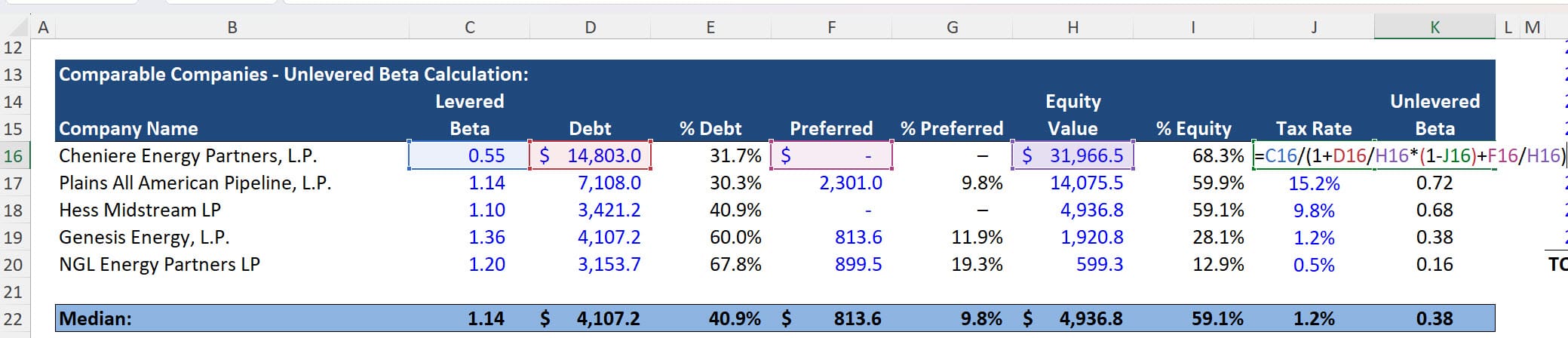
Dividing by a term that starts with “1 +” ensures that Unlevered Beta will always be less than or equal to Levered Beta.
Once you have this for all the peer companies, you can take the median and “re-lever Beta” by multiplying by this term instead:
Re-Levered Beta = Unlevered Beta * (1 + Debt / Equity * (1 – Tax Rate) + Preferred / Equity)
“Re-levering” Beta takes the operational risk from the comparable companies and then adjusts it based on this company’s risk from leverage:

You could use either the subject company’s current capital structure or the peer companies’ median numbers; we tend to do both to capture a range of values for the Cost of Equity.
Alternate Methods for Calculating the Cost of Equity Based on Dividends and Net Income
In addition to the methods above, you can also calculate the Cost of Equity based on Dividends or Net Income.
The formulas are simple:
The Dividend method works best for mature, stable companies that issue Dividends on a predictable basis, such as utilities or banks.
The Net Income method is more common for assessing EPS accretion/dilution in M&A deals, but it can also work for standalone companies.
For Western Midstream Partners here, the projected “Distribution Yield” is 8.3%.
The Distribution Growth Rate varies, but it’s in the 3 – 4% range over the next several years of the projection model.
So, based on Dividends, the Cost of Equity is in the 11 – 12% range for this company (probably on the high side).
With the other method, Western Midstream’s projected Net Income was $1.4 billion, and its Market Cap at the time of this analysis was $15.7 billion, so its Cost of Equity was approximately 9%.
You can see how all these methods compare below:
The Cost of Equity for Startups, Speculative Companies, and Private Assets
Outside of mature/public companies, the Cost of Equity could be almost anything.
For example, it’s not unusual to see Discount Rates of 30%, 50%, or even 70%+ for tech startups, depending on their stage and revenue.
These numbers are not based on the Equity Risk Premium or Levered Beta, but rather the high expected failure rate for most startups.
Rough guidelines for the Discount Rate by startup stage might be:
- Seed: 50 – 70%+
- Series A: 30 – 50%
- Series B: 20 – 30%
- Series C / D / Beyond: 10 – 20%
In a startup DCF, you would normally start at a very high Discount Rate and then scale it down over time as the startup grows and generates revenue.
Companies in emerging/frontier markets and stressed/distressed companies are also in this category.
There are no universal guidelines for these firms, but you calculate the Cost of Equity the normal way and then add a risk premium to account for the uncertainty around geopolitics or the company’s turnaround plan.
Finally, in some industries, such as Project Finance and Real Estate, the Cost of Equity is based on investors’ targeted equity returns.
In other words, if an infrastructure company targets a 12% Equity IRR when developing new solar plants, its Cost of Equity for all such developments will be 12%.
You can then compare the projected Equity IRR to this 12% Cost of Equity to assess projects.
It’s similar to comparing the Return on Equity (ROE) and the Cost of Equity for banks and financial institutions.
The Cost of Equity vs. the Cost of Debt and Changes in Different Scenarios
The Cost of Equity is higher than the Cost of Debt because of the risk/return profile, the seniority, and the tax treatment.
Common shareholders take on far more risk than lenders (Debt investors) because a company’s stock price could move in any direction.
But a corporate bond is highly unlikely to drop by 90%+ unless the company implodes.
The bondholders receive fixed payments in each period based on the stated coupon rate, so there’s also far less risk of failing to earn the targeted returns.
The lenders are senior to the common shareholders because they have a higher claim to the company’s assets in a bankruptcy or liquidation, which also reduces their risk.
Finally, the interest paid on Debt is tax-deductible, while Dividends paid to the common shareholders are not, so the Cost of Debt tends to be lower due to the multiplication by this (1 – Tax Rate) term in the formula.
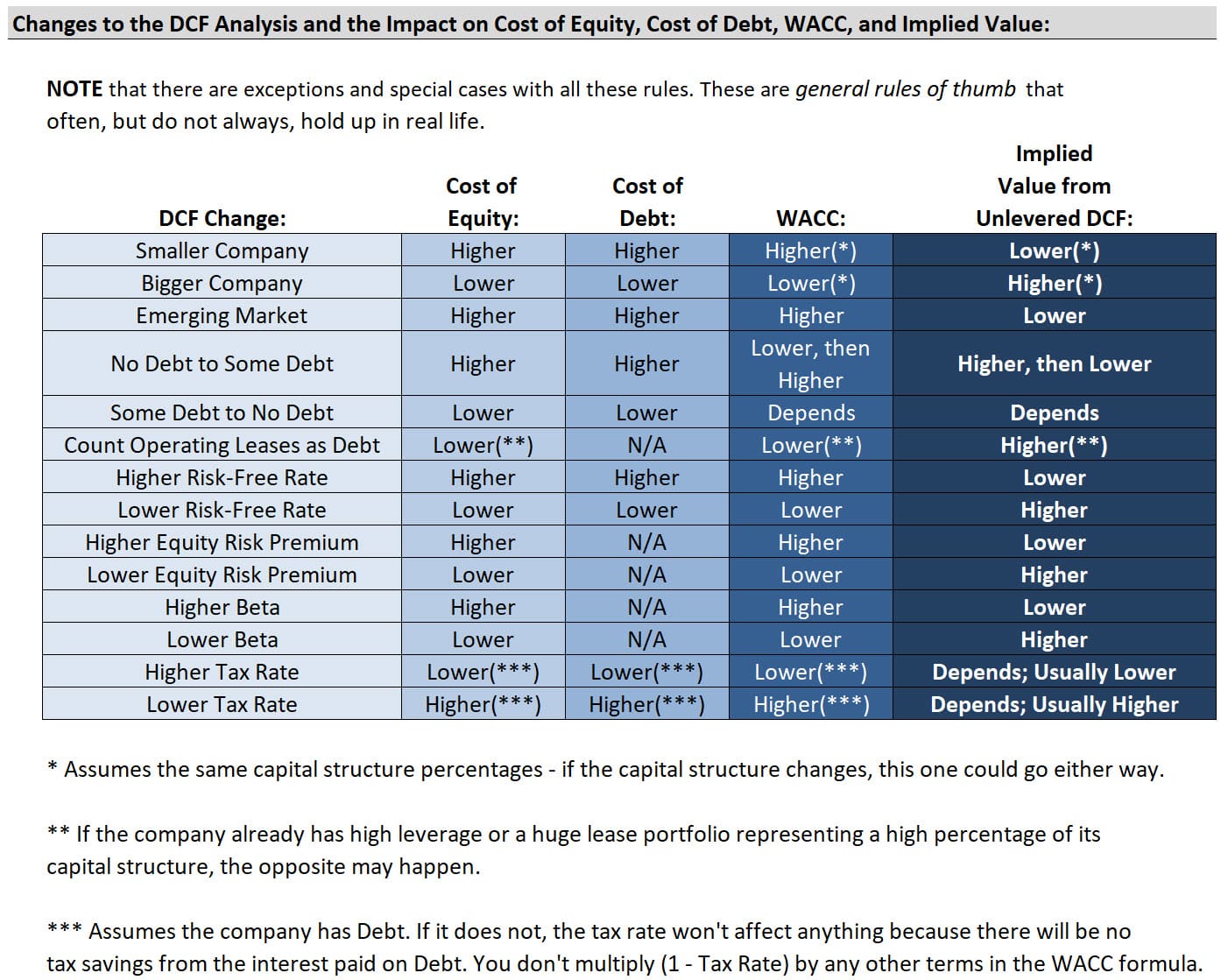
“Variable X” could be the Risk-Free Rate, Equity Risk Premium, Beta, the Company Size, or dozens of other factors.
When in doubt, think: “Is the overall risk higher or lower with this change?”
For example, smaller companies are usually riskier than larger ones, so the Cost of Equity tends to be higher for smaller companies.
Since the Risk-Free Rate and Equity Risk Premium are both additions in the Cost of Equity formula, higher values for these increase the Cost of Equity, while lower values reduce it.
You can see a set of potential changes and their effects below:

About Brian DeChesare
Brian DeChesare is the Founder of Mergers & Inquisitions and Breaking Into Wall Street. In his spare time, he enjoys lifting weights, running, traveling, obsessively watching TV shows, and defeating Sauron.

