


The Times Interest Earned (TIE) Ratio: Real-World Risk or Spreadsheet Swindle?
The Times Interest Earned Ratio, also known as the Interest Coverage Ratio, measures how well a company’s core-business earnings can pay for the interest expense on its Debt and represents its credit risk and additional capacity for Debt issuances; there are many different definitions because there are different types of “earnings” and “interest expense.”
The Times Interest Earned (TIE) Ratio: Real-World Risk or Spreadsheet Swindle?
Times Interest Earned (TIE) Definition: The Times Interest Earned Ratio, also known as the Interest Coverage Ratio, measures how well a company’s core-business earnings can pay for the interest expense on its Debt and represents its credit risk and additional capacity for Debt issuances; there are many different definitions because there are different types of “earnings” and “interest expense.”
Some sources say that the “core-business earnings” should be EBITDA, or Earnings Before Interest, Taxes, Depreciation & Amortization, while others state that it should be EBIT, or Earnings Before Interest & Taxes, to be more conservative:
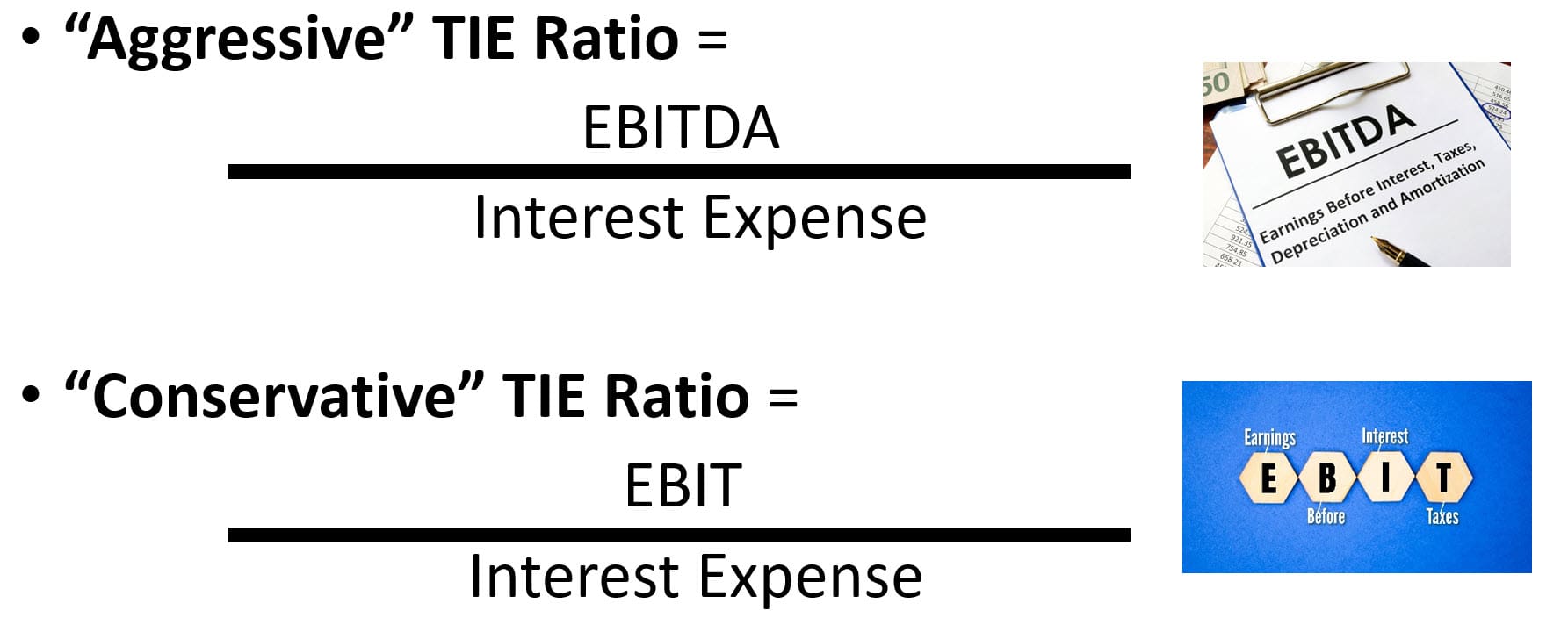
For example, if a company has $10 million in EBITDA and $8 million in EBIT, and its Interest Expense is currently $2 million, its TIE is either 5.0x or 4.0x.
“Reasonable” and “targeted” levels vary by industry and company stage, but in most cases, a TIE in the 4 – 5x range is healthy and indicates that the company can easily service its Debt.
Assuming its other credit stats, such as the Leverage Ratio and Fixed Charge Coverage Ratio (FCCR), also look good, this company should be able to raise new Debt easily.
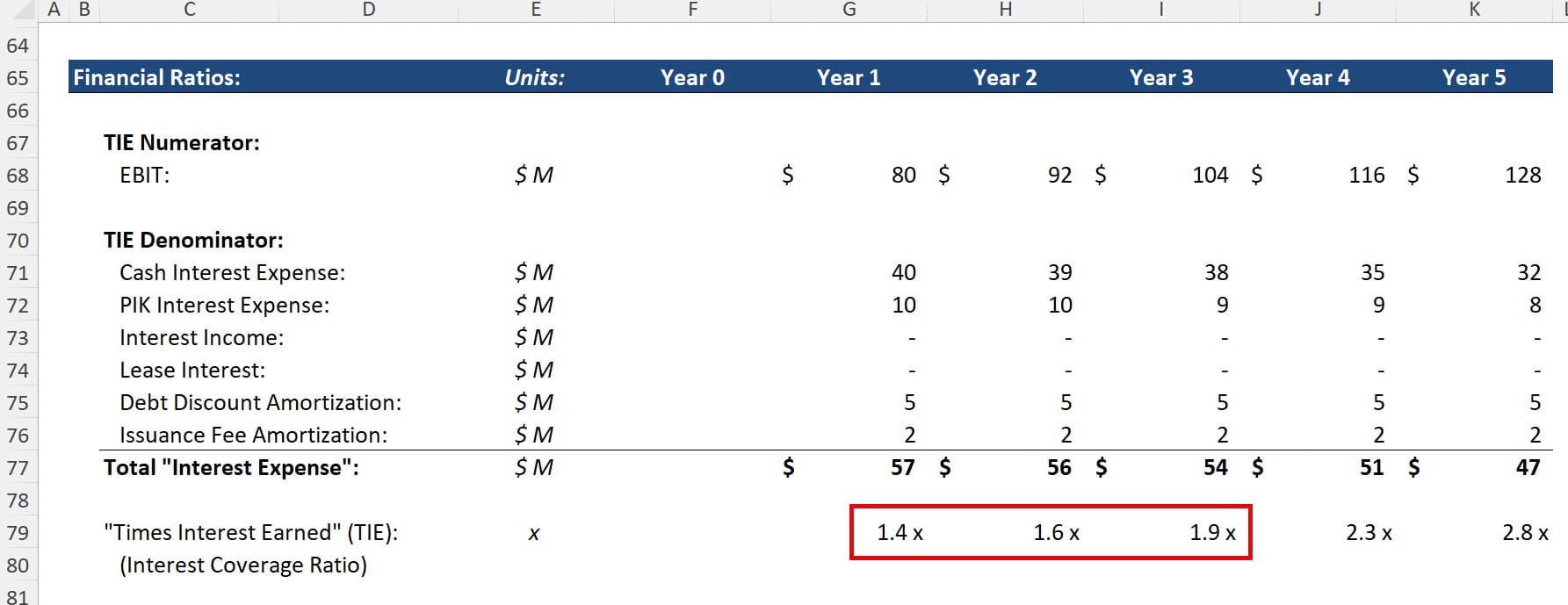
If this same company had a much lower TIE, such as 2.0x or below, it wouldn’t necessarily be a “red flag,” but it would indicate a reduced ability to issue new Debt:
The TIE or Interest Coverage Ratio is widely used in everything from small-business credit assessments to debt vs. equity analysis, leveraged buyout models, and real estate models.
The calculations differ, but the concept is the same: It always measures how easily a company can pay for its Interest Expense and, therefore, how well it can service its current Debt and potentially issue new Debt.
Files & Resources:
- Simple LBO Model – Times Interest Earned (TIE) Calculations (XL)
- Times Interest Earned (TIE) – Slides (PDF)
Video Table of Contents:
- 0:00: Introduction
- 5:34: Part 1: TIE Definitions in a Simple LBO Model
- 10:51: Part 2: What Does TIE Tell You?
- 13:07: Part 3: How Companies Can Boost Their TIEs
- 14:31: Recap and Summary
How Do You Define the Times Interest Earned Ratio? Why Does Everyone Do It Differently?
There are different definitions because of different standards, which vary by group and firm, and because of incentives.
For example, borrowers often want to use strict definitions of “Interest Expense” and broad definitions of “Earnings.”
If the denominator is smaller and the numerator is bigger, that always improves the TIE Ratio and makes the company look better.
A few complications with Interest Expense may include:
- Cash vs. Non-Cash (PIK) Interest: If the company has accrued or PIK Interest, do you count that? Or is it only the Cash Interest Expense in the period?
- Net Interest: If the company also earns Interest Income on its Cash balance, do you net that against the Interest Expense or ignore it and use only the Interest Expense?
- Lease Interest: Especially under IFRS, many companies have significant “Lease Interest” since they split the Lease Expense into Depreciation and Interest components. Lease Interest is a cash expense, but Leases are not quite Debt, so the treatment is debatable.
- Non-Cash Interest Components: If the company has Debt with issuance fees or Debt that was issued at a discount or premium to par value, these items amortize over time and are typically counted within the Interest Expense. But the cash costs are incurred upfront; the amortization itself is non-cash.
The argument against counting these items in the “Interest Expense” is simple: They are not cash expenses, so they do not impair the company’s ability to service its Debt in the current period.
The argument for counting them is that they do tell you something about the company’s credit quality and ability to raise additional Debt.
For example, if a company has $100 in Interest Expense, with $70 in Cash Interest, $20 in PIK Interest, and $10 from an Original Issue Discount Amortization, these non-cash components tell you that the company’s credit risk is higher than expected.
If the lenders had been satisfied with earning $70 in Cash Interest on their Debt, why would the company have offered PIK Interest and sold this Debt at a substantial discount?
The investors wanted more to compensate them for the risk, so it is fair to count these components toward the Interest Expense and numbers like the Cost of Debt.
The numerator used in the TIE Ratio is also open to interpretation.
EBITDA is the most aggressive metric, while EBIT is more conservative since it deducts Depreciation & Amortization, partially reflecting the company’s capital costs.
Some argue that EBITDA is better for “capital-intensive firms,” while EBIT is better for asset-light companies, but this misses the point.
EBIT is always less than or equal to EBITDA for all companies, so EBIT is always a more conservative metric.
You should not adjust for Cash Flow Statement line items, such as the Change in Working Capital or Capital Expenditures, in the numerator of this Times Interest Earned number.
If you start doing that, you might as well use the Debt Service Coverage Ratio or the Fixed Charge Coverage Ratio, as they are linked more closely to cash flows than earnings.
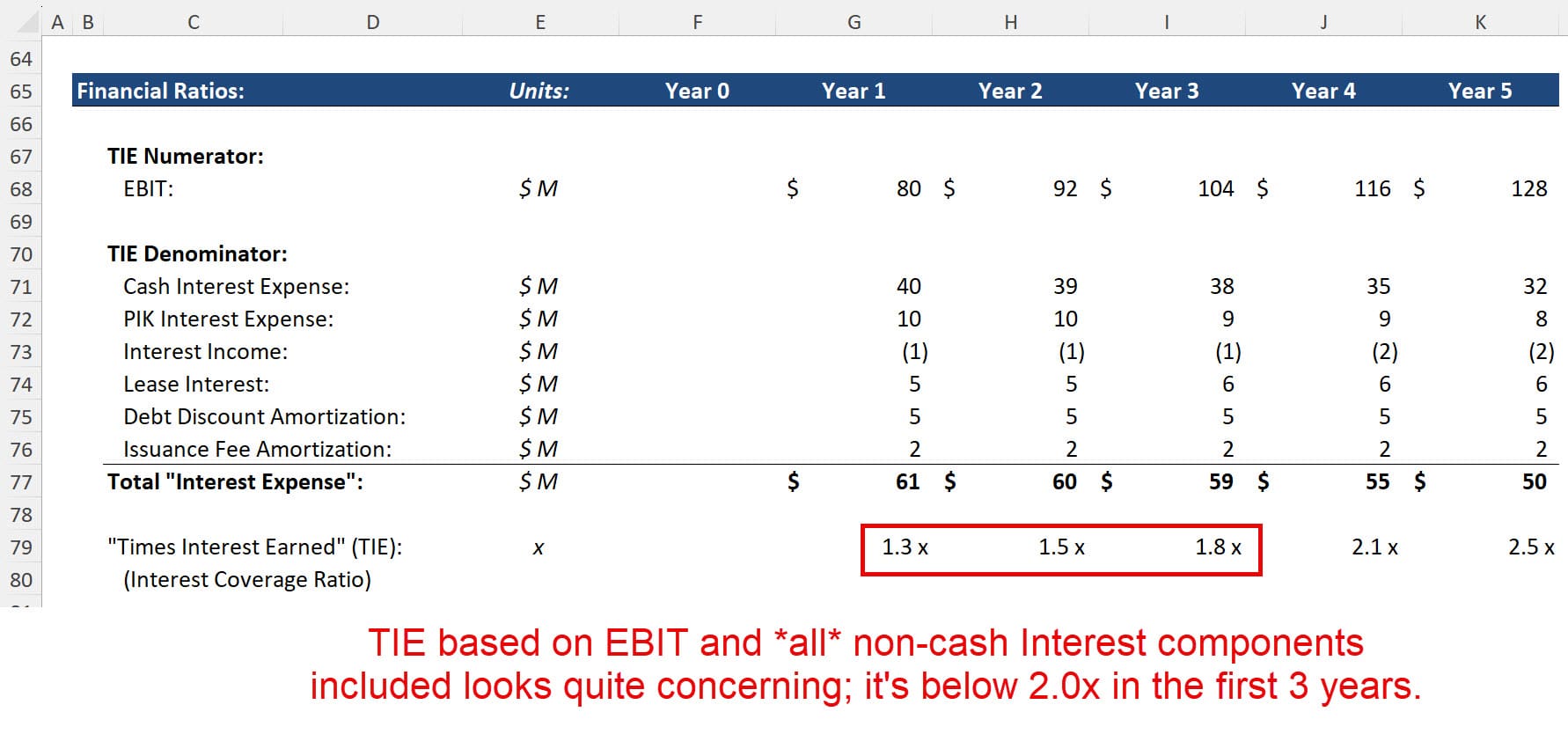
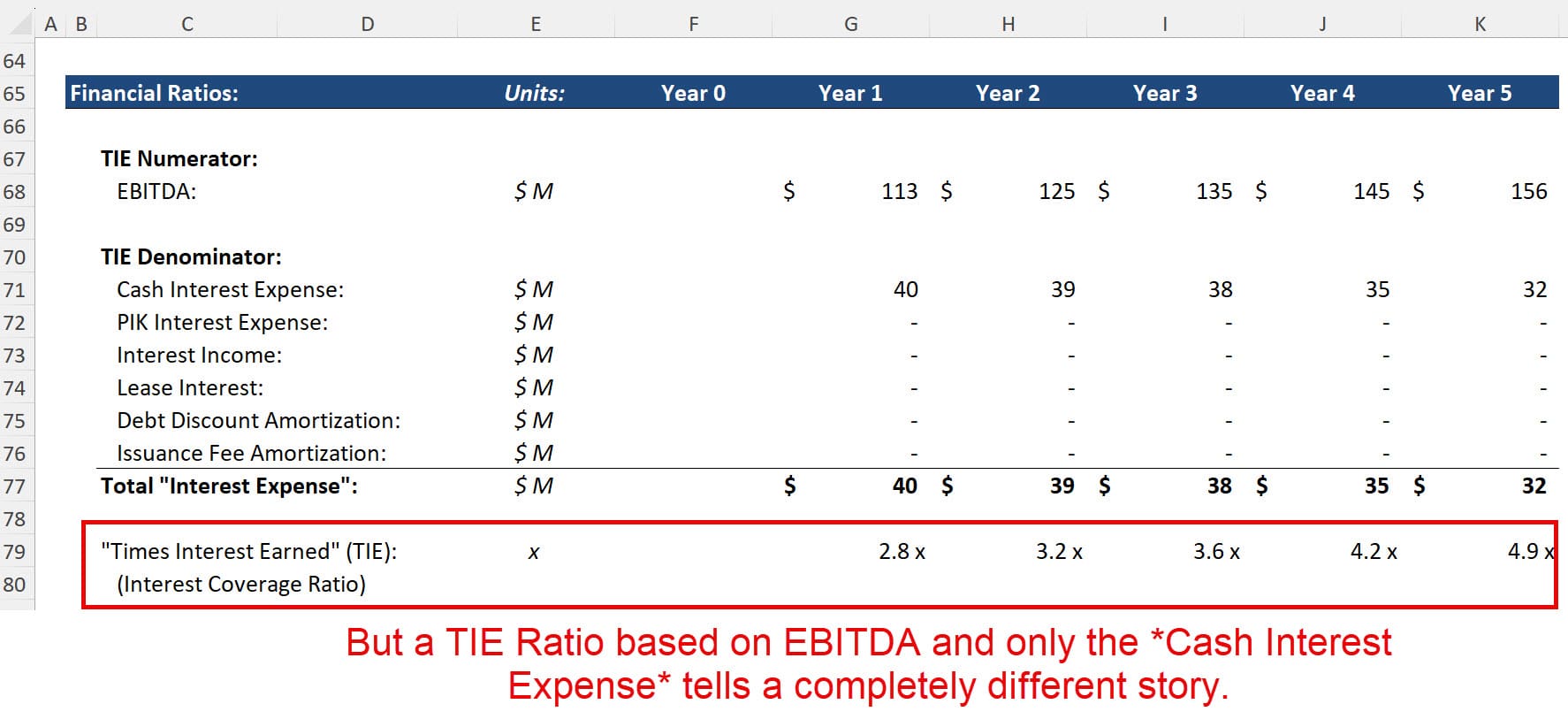
You can see how much the exact definitions matter in the examples below:

-
Become a financial modeling pro
158 videos, detailed written guides, Excel files, quizzes, and more
-
Complete 10+ detailed global case studies
These include both the theory and the practical applications
-
Prepare for your internship or full-time job
Gain the skills you need to “hit the ground running” on Day 1
What Does the Times Interest Earned Ratio Tell You? Is It Useful or Misleading?
Measuring the TIE Ratio is a bit like going to the doctor, getting a blood test, and then reviewing a single metric in the test, such as your LDL-C (the “bad cholesterol”) or the creatinine, which measures your kidney function.
If you get a single “bad” number, it doesn’t mean that your heart or kidney will explode and that you’ll die tomorrow.
Instead, you must view this measurement in context.
What do your other numbers look like? Is everything else in line with the norms, or are there other troubling signs? What do your nutrition, sleep, stress, and exercise look like?
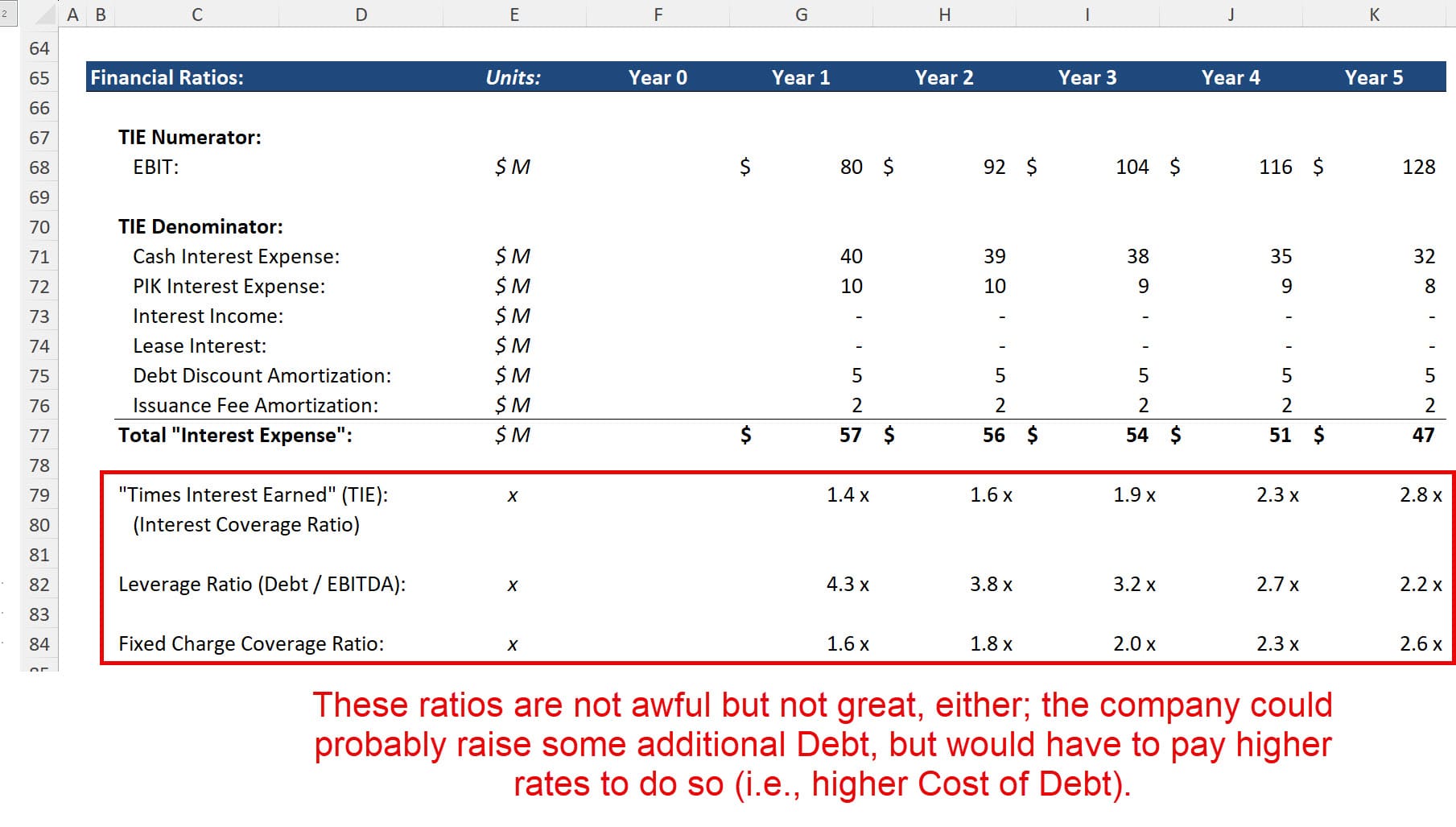
It’s the same with the TIE Ratio, which is why you always look at it in conjunction with other metrics, such as Debt / EBITDA, Debt / Equity, the Fixed Charge Coverage Ratio, and the Debt Service Coverage Ratio.
So, if a company’s TIE Ratio is on the low side – say, around 2.0x – but the rest of its metrics look fine, it might be able to raise additional Debt on similar terms to its current issuance.
But if everything else is questionable – maybe Debt / EBITDA over 5.0x and a FCCR just above 1.0x – then lenders will be more reluctant or might demand higher interest rates:
How Can Companies Boost Their Times Interest Earned Ratios?
Anything that reduces the company’s Debt balance or Interest Expense while maintaining or improving its core business will increase the Times Interest Earned Ratio.
For example, selling non-core assets and using the proceeds to repay Debt is a common strategy to improve a company’s TIE.
This works because income from these non-core assets should not be part of EBIT or EBITDA, so this action keeps the numerator the same but reduces the denominator, as a lower Debt balance means reduced Interest Expense.
Other strategies include:
- Refinance the company’s current Debt and replace it with lower-interest-rate Debt in exchange for other concessions, such as stricter covenants.
- Cut costs by reducing the company’s headcount and renegotiating leases or supplier contracts.
- Grow the core business, so that EBIT and EBITDA increase in future periods, producing lower TIE Ratios.
To TIE or Not to TIE: Final Thoughts on the Times Interest Earned Ratio
Our view is that the TIE Ratio is good for a “quick and dirty” analysis, but less useful once you go into more depth on a company, property, or deal.
Although it seems simple, the different definitions and the nuance around the non-cash components of Interest make the interpretation trickier than expected.
Even comparing different companies can sometimes be challenging because of these issues.
We prefer ratios such as the DSCR or FCCR because they more effectively compare the cash flows to the total Debt Service.
“Debt Service” includes both Interest and Scheduled Principal Repayments and, therefore, gives a more complete picture of the company’s ongoing obligations.
So, the Times Interest Earned Ratio is a useful screening tool or as “Step 1” in your analysis, but its usefulness falls by the time you reach “Step 10.”

About Brian DeChesare
Brian DeChesare is the Founder of Mergers & Inquisitions and Breaking Into Wall Street. In his spare time, he enjoys lifting weights, running, traveling, obsessively watching TV shows, and defeating Sauron.

