


Deferred Revenue: How an “Easy” Interview Question Makes Real Life Confusing
Deferred Revenue, as traditionally defined, refers to cash that a company has received *before* the company has delivered the product or service; it cannot yet recognize these funds as revenue due to the lack of delivery. In a subscription/SaaS context, Deferred Revenue may also be recognized when a contract is signed, even if the customer has not yet paid upfront in cash.
Deferred Revenue: How an “Easy” Interview Question Makes Real Life Confusing
Deferred Revenue Definition: Deferred Revenue, as traditionally defined, refers to cash that a company has received *before* the company has delivered the product or service; it cannot yet recognize these funds as revenue due to the lack of delivery. In a subscription/SaaS context, Deferred Revenue may also be recognized when a contract is signed, even if the customer has not yet paid upfront in cash.
In traditional accounting, Deferred Revenue, also known as Unearned Revenue or Customer Deposits, represents cases in which a company has collected cash from customer(s) before delivering the product or service.
You can think about Deferred Revenue vs. related Working Capital line items with this 2×2 matrix:
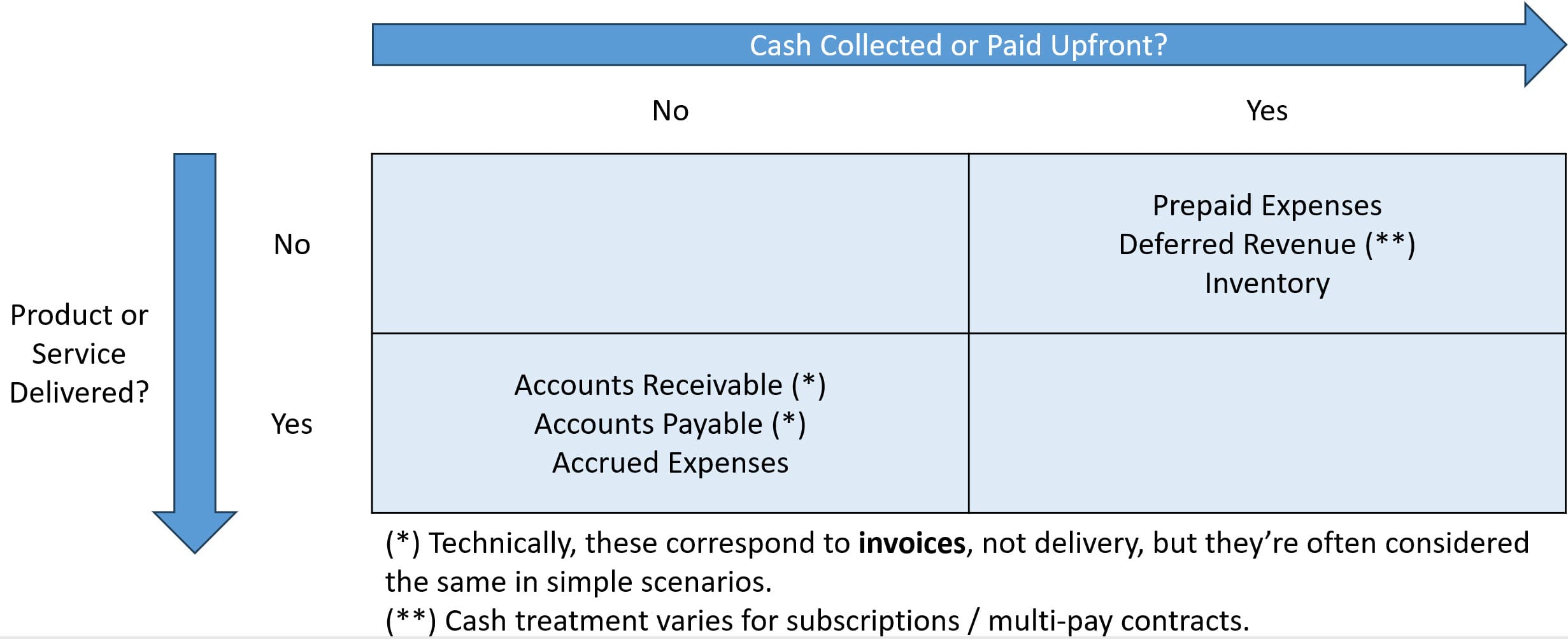
Deferred Revenue is always a Liability on the Balance Sheet because it means the company now has an obligation to deliver this product or service, which will cost something.
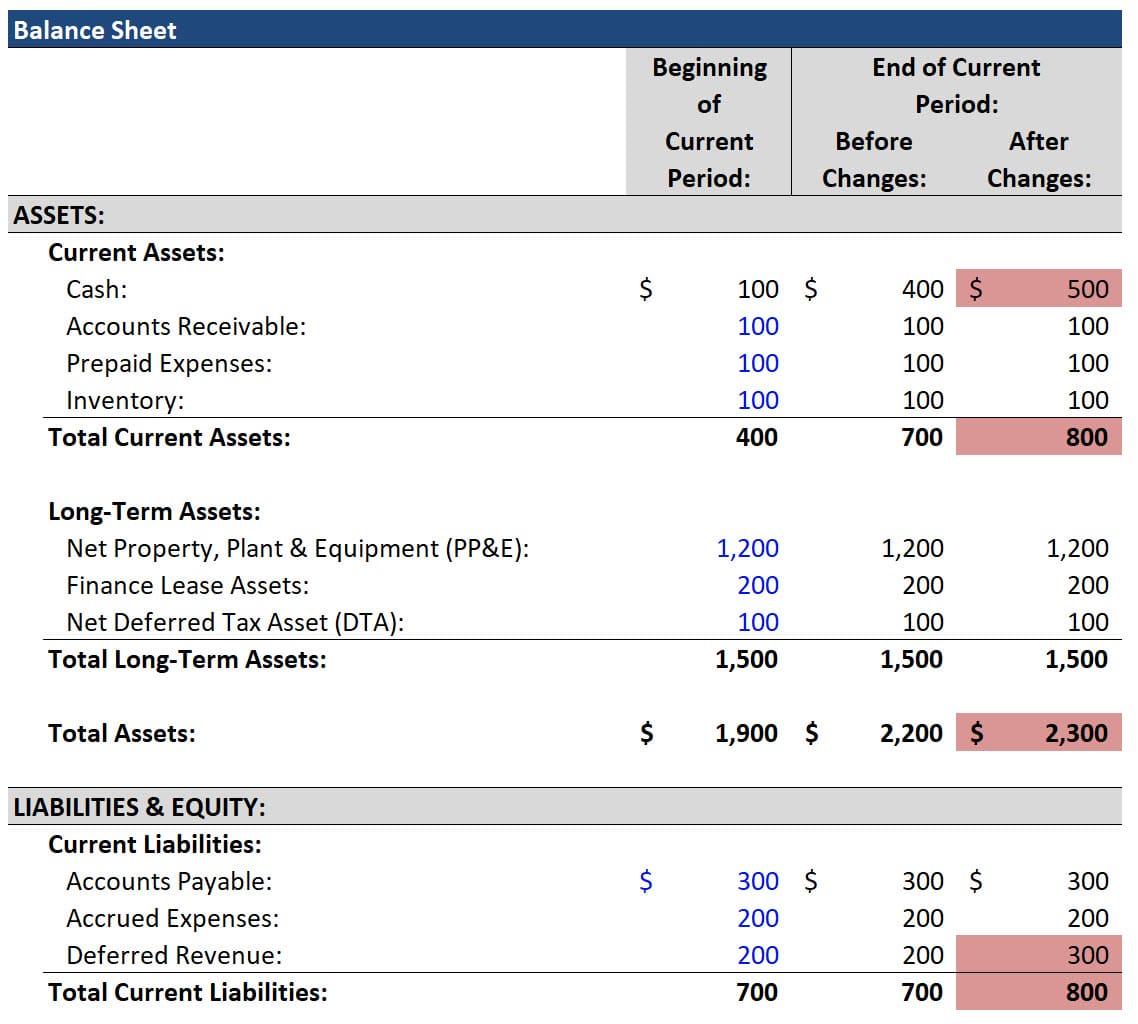
When DR is first recorded, Cash on the Assets side increases, and Deferred Revenue on the L&E side increases to balance it. The Income Statement does not change because no Revenue can be recognized until the delivery takes place.
For example, if a company sells a $100 widget to a customer and collects the $100 in cash upfront before the delivery, Cash on the Assets side increases by $100, and Deferred Revenue increases by $100 on the L&E side:
When the delivery takes place, the company recognizes $100 in Revenue on the Income Statement:
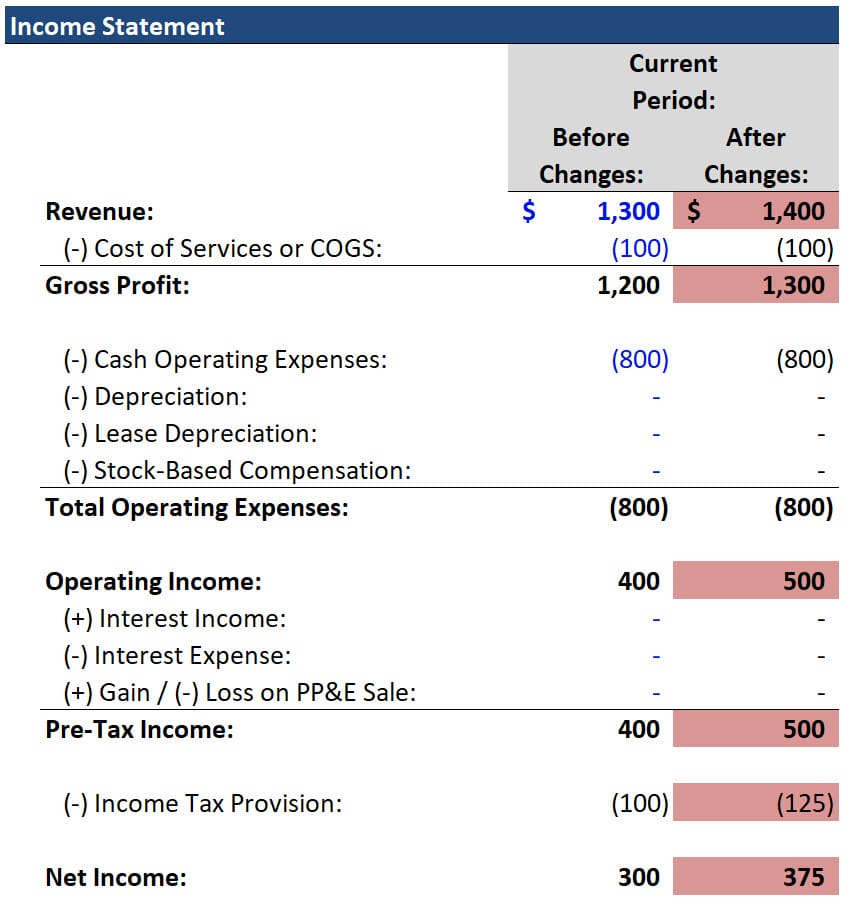
If there are no associated expenses, Pre-Tax Income increases by $100, and Net Income increases by $75 at a 25% tax rate.
On the Cash Flow Statement, Net Income is up by $75, and the previous Deferred Revenue increase reverses, so Cash at the bottom is up by $75.
On the Balance Sheet, Cash is up by $75, so Total Assets are up by $75.
On the L&E side, Deferred Revenue has returned to its original level, so there is no net change (it went up by $100 and then down by $100).
Equity is up by $75 due to the increased Net Income, so both sides are up by $75 and balance:
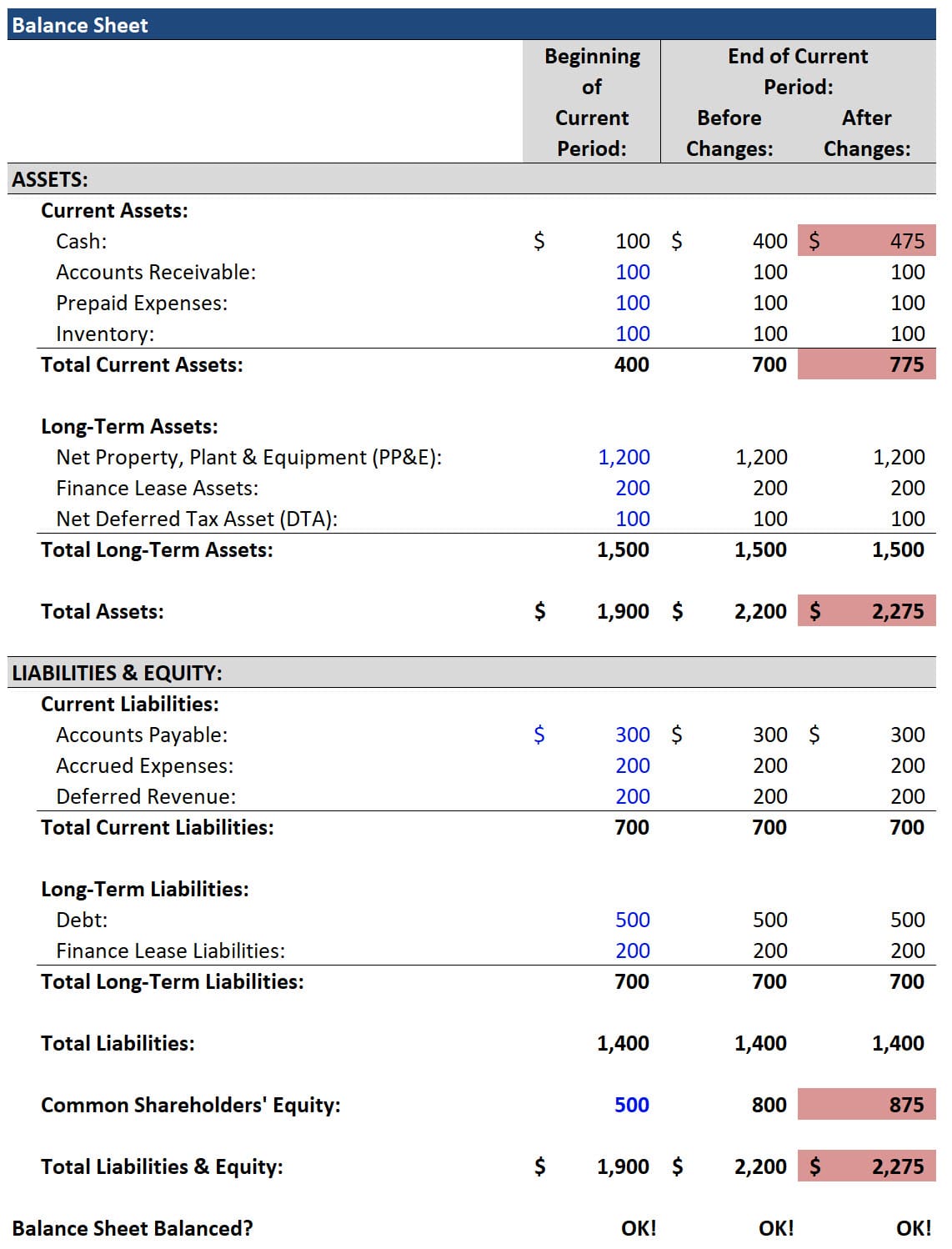
Intuition: The company earns an additional $100 in Revenue, has no associated expenses, and pays $25 in taxes on it, so its Cash is up by $75.
In a SaaS or subscription context, Deferred Revenue works differently and typically corresponds to invoices rather than upfront cash collection because customers normally sign contracts, wait to pay in cash, and then get the product or service delivered over time.
If there is 100% upfront cash collection, the description above still applies – but if not, Accounts Receivable, rather than Cash, increases in the first step.
The files below demonstrate these scenarios:
Files & Resources:
- Accounting “Interview Question” Model – Deferred Revenue Example (XL)
- SaaS Accounting Examples (XL)
- Deferred Revenue – Presentation Slides (PDF)
Video Table of Contents:
- 0:00: Introduction
- 5:46: Part 1: Deferred Revenue with Delivery Expenses
- 7:40: Part 2: Why is Deferred Revenue a Liability?
- 9:28: Part 3: Deferred Revenue in SaaS Accounting
- 13:48: Recap and Summary
Deferred Revenue with Associated Delivery Expenses
The obvious follow-up question to the scenario above is:
“Wait a minute. It always costs something to deliver a product or service, even if it’s software or some other digital product. What happens if you record something for the Cost of Services?”
In the initial step, nothing changes. Deferred Revenue and Cash are both up by $100, assuming full upfront cash collection.
In Step 2, you still recognize $100 of Revenue on the Income Statement, but you also record something for the delivery costs (e.g., customer support, bandwidth/infrastructure, payment processing fees, etc.).
If you assume the Cost of Services or COGS here are $20, Pre-Tax Income increases by $80 rather than $100, and Net Income increases by $60 at a 75% tax rate:
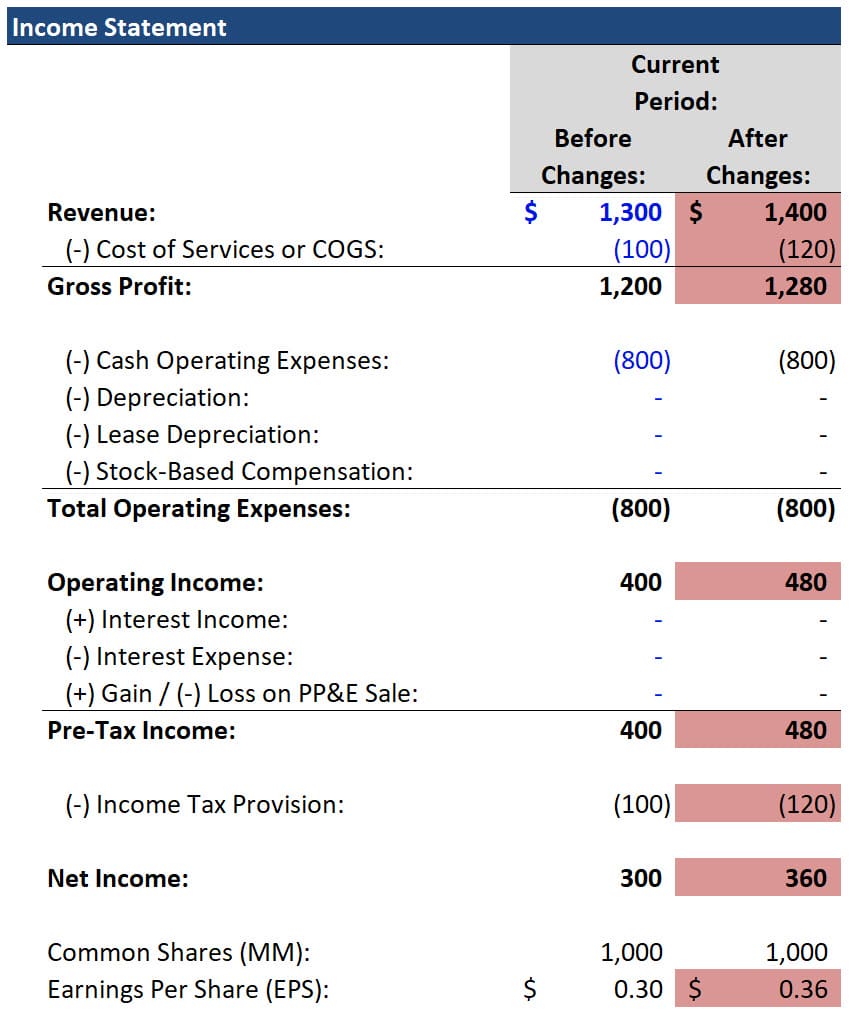
On the CFS, Net Income is up by $60, the Change in DR reverses, and Cash is up by $60 at the bottom.
On the Balance Sheet, Cash is up by $60 on the Assets side, and Equity is up by $60 on the L&E side due to the increased Net Income, so both sides balance:
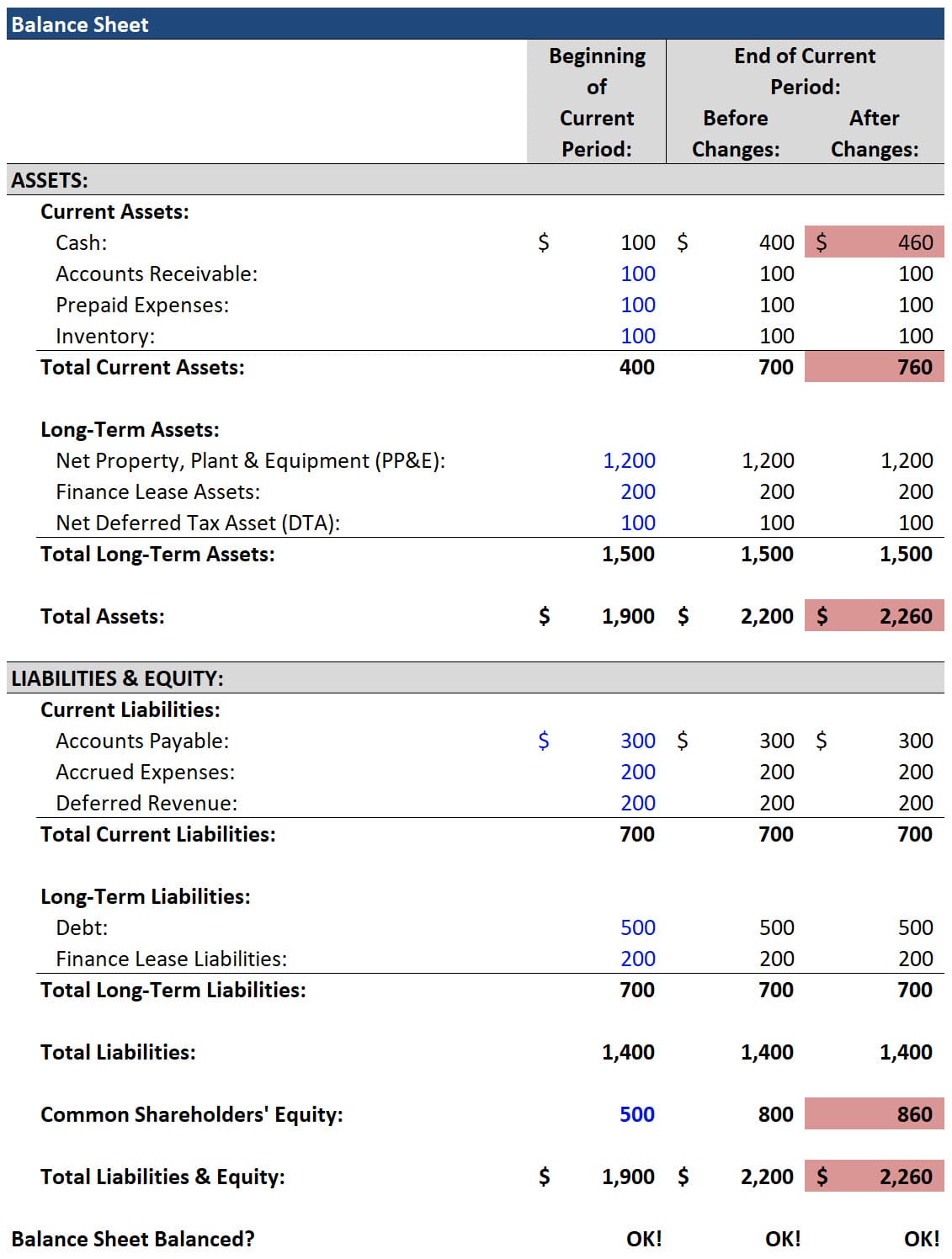
The intuition is that the company has sold something and generated after-tax profits, but less than before, since it has delivery expenses this time.
NOTE: This example assumes that these “delivery costs” were not recorded anywhere on the Balance Sheet in advance. That may not be true in real life, so you will sometimes see line items like “Deferred Costs” to recognize this.
Why is Deferred Revenue a Liability?
Deferred Revenue is a Liability because once a company has collected the cash, it cannot “earn” anything more from the sale.
Instead, it must fulfill an obligation and will likely incur additional expenses to do so (whether in COGS, Operating Expenses, or Taxes).
If Deferred Revenue and Accounts Receivable increase at the same time, yes, the AR should eventually “transfer” to Cash, but the company still cannot “earn” anything additional from the transaction.
In the future, it will record additional expenses or cash outflows associated with it.
So, like any Liability, it represents an obligation or future cash outflow.
Deferred Revenue vs. Accrued Revenue vs. Accounts Receivable
Accrued Revenue is the opposite of Deferred Revenue: It represents cases where the company has delivered a product or service but has not yet received the cash payment from the customer(s).
It’s like Accounts Receivable, but Accounts Receivable typically has a specific invoice attached and corresponds to the submission of this invoice.
For example, Accounts Receivable might be created slightly before the product/service has been delivered if the customer has been invoiced for it (as in the SaaS examples here).
However, Accrued Revenue would not be created just because of an invoice; it gets recorded only when the delivery takes place.
Both Accrued Revenue and Accounts Receivable are Assets that get “converted” into Cash when payment is received.
Deferred Revenue, by contrast, is a Liability that increases upon cash payment receipt (or contract signing), but it does not “convert” into Cash. Instead, it is recognized as Revenue upon delivery.
Deferred Revenue in a SaaS Context: Bookings, Billings, and Recognized Revenue
For subscription services, such as for software companies that sell annual or multi-year subscriptions, Deferred Revenue works a bit differently.
With subscriptions, the Deferred Revenue is recognized when the contract is signed, even if the customer has not yet paid in cash.
We cover the standard treatment in our tutorial on SaaS accounting, but here is a quick summary using simple numbers:
Suppose that a company offers contracts that cost $120 per year.
The company bills customers twice per year for $60 each time, so each customer receives a $60 invoice every 6 months.
The invoices are “Net 90,” i.e., the customer has ~3 months to submit payment, and the company expects to collect the cash within 90 days for each customer.
If a contract is signed on January 1 of the year, and the initial invoice is sent on that date, both Accounts Receivable and Deferred Revenue increase by $60.
By the end of January, Accounts Receivable is still at $60 because no cash has been collected.
However, $10 of Revenue is recognized because of the delivery of this software over the month, and the Deferred Revenue balance decreases by $10:
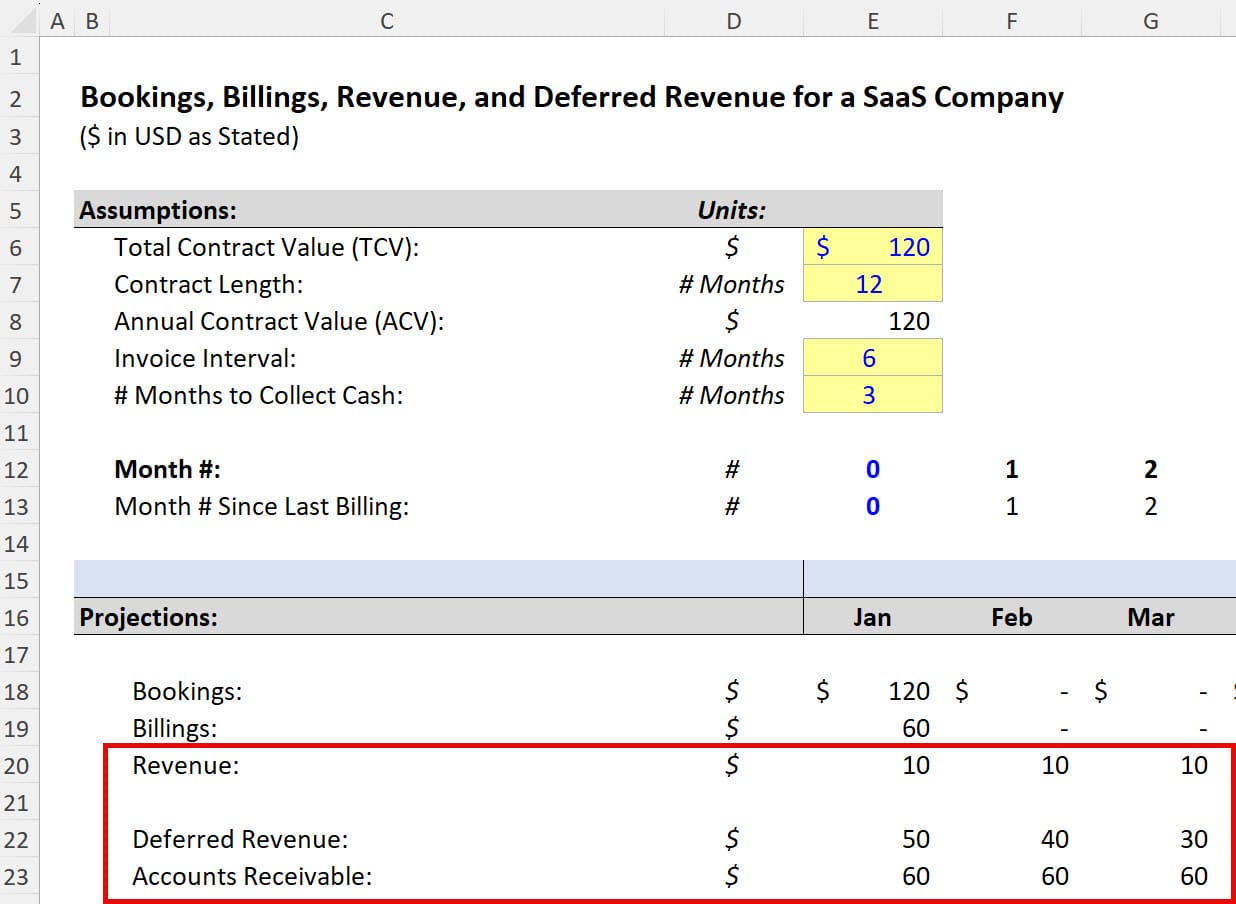
In each month after this, $10 of Revenue is recognized, and the DR balance falls by $10.
At the end of March, the cash collection finally takes place, so the AR balance drops to $0, which is reflected in the next month (April).
The invoice cycle ends in June, and on July 1, the customer receives another invoice for $60, and this same cycle starts again:


-
Become a financial modeling pro
158 videos, detailed written guides, Excel files, quizzes, and more
-
Complete 10+ detailed global case studies
These include both the theory and the practical applications
-
Prepare for your internship or full-time job
Gain the skills you need to “hit the ground running” on Day 1
Deferred Revenue on the 3 Financial Statements in a SaaS Context
Suppose that a company has an initial Cash balance of $1,000 and sells a 12-month contract worth $1,200.
It invoices customers every 4 months with “Net 60” terms (i.e., it takes 2 months to collect the cash from each customer).
When the invoice is first issued, both AR and DR increase by $400:
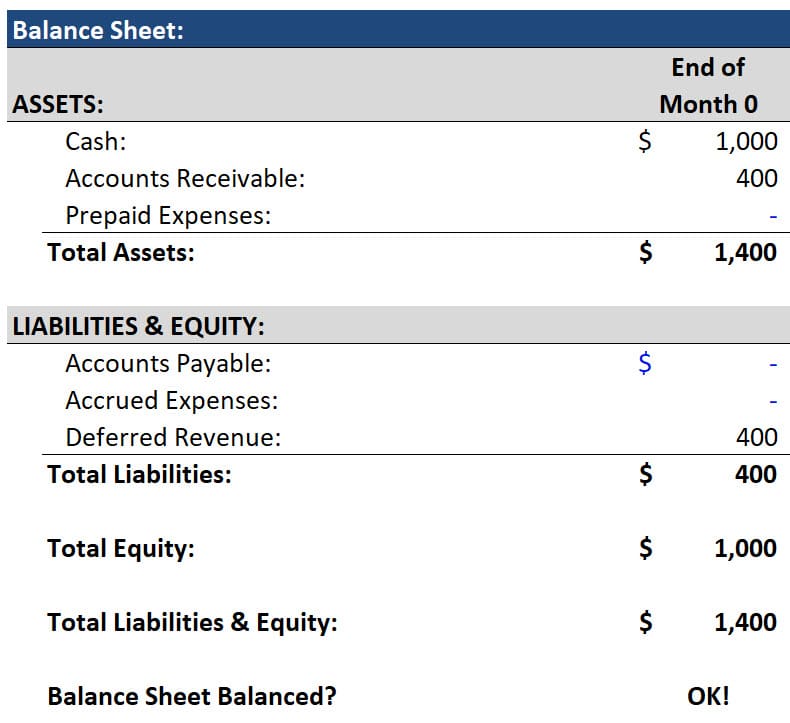
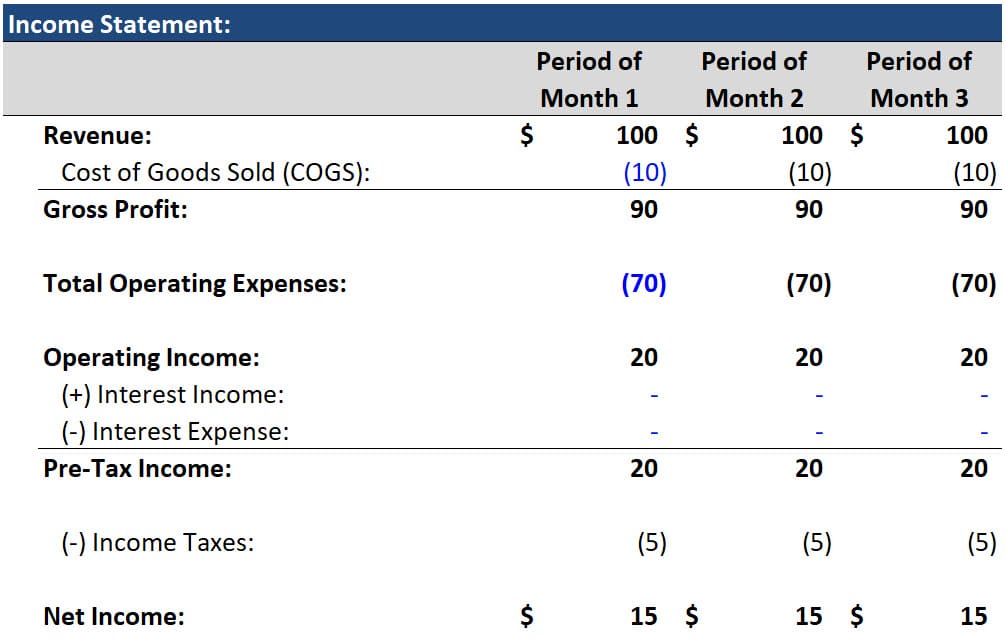
On the Income Statement each month, $100 of Revenue is recognized, corresponding to this $1,200 contract over 12 months ($1,200 / 12 = $100):
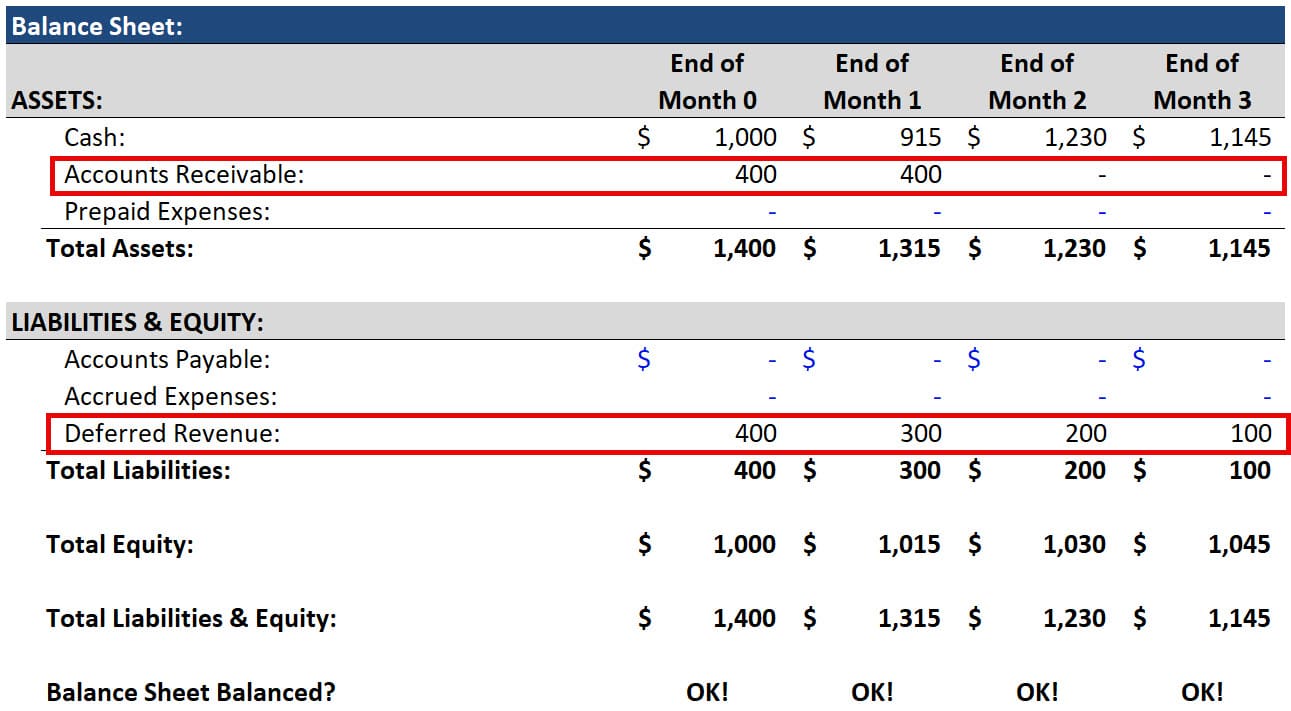
On the Balance Sheet, AR is $400 for the first 2 months but falls to $0 by the end of Month 2 as the cash is collected; the DR starts at $400 and decreases by $100 each month:
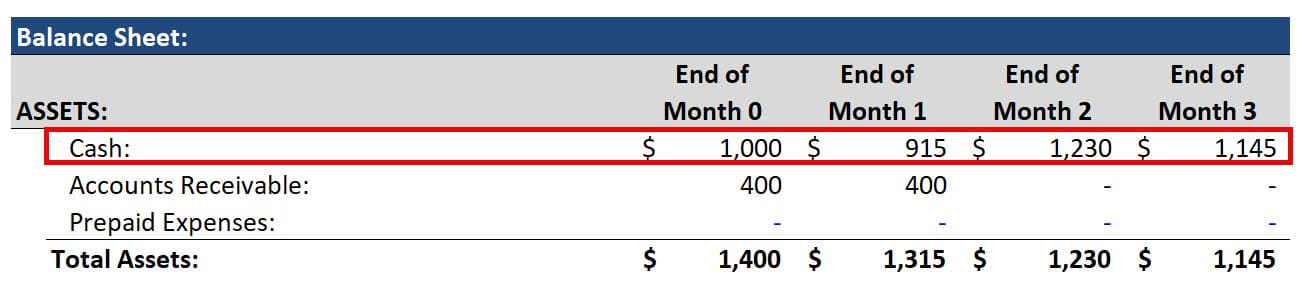
The Cash balance decreases as Revenue is recognized, but it increases in Month 2 when the AR is collected.
It then falls between Month 2 and Month 3 because no additional cash is collected, but the company pays taxes and expenses on the $100 of recognized Revenue:
Deferred Revenue in Interviews
In an interview context, you are unlikely to receive complicated questions about Deferred Revenue.
You should know the basics for single-fee, non-subscription sales, but these scenarios with subscriptions are likely only if you have more experience or you’re interviewing for a role where these concepts are important, such as in venture capital, growth equity, or a tech-focused group or bank.

About Brian DeChesare
Brian DeChesare is the Founder of Mergers & Inquisitions and Breaking Into Wall Street. In his spare time, he enjoys lifting weights, running, traveling, obsessively watching TV shows, and defeating Sauron.

