


About Brian DeChesare
Brian DeChesare is the Founder of Mergers & Inquisitions and Breaking Into Wall Street. In his spare time, he enjoys lifting weights, running, traveling, obsessively watching TV shows, and defeating Sauron.
On the Cash Flow Statement, the Cash Flow from Operations (CFO) section starts with Net Income from the Income Statement, adjusts for non-cash income and expenses, and reflects the Change in Working Capital (either positive or negative); CFO represents a company’s recurring cash flow *before CapEx* and other investing/financing activities.
Cash Flow from Operations Definition: On the Cash Flow Statement, the Cash Flow from Operations (CFO) section starts with Net Income from the Income Statement, adjusts for non-cash income and expenses, and reflects the Change in Working Capital (either positive or negative); CFO represents a company’s recurring cash flow *before CapEx* and other investing/financing activities.
Some companies also use the Direct Method for their Cash Flow Statements, in which case Cash Flow from Operations will be based on cash inflows (receipts from customers) and cash outflows (payments to suppliers, employees, etc.). You will need to find a reconciliation to a CFS that starts with a metric such as Net Income if the company does this.
Two basic definitions for Cash Flow from Operations are as follows:
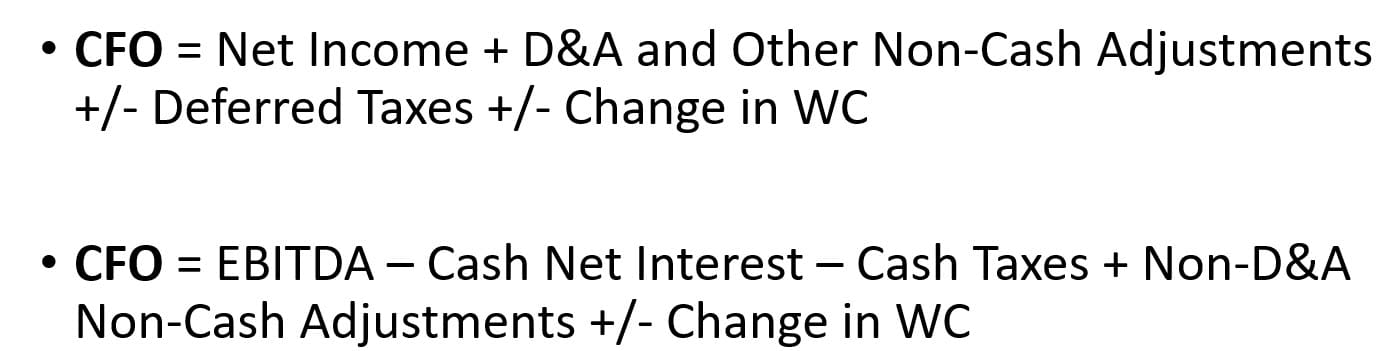
However, it is rarely this simple for real-life companies.
They often have many additional non-cash adjustments beyond Depreciation & Amortization, and parts of the CFO section may need to be recategorized, especially for non-U.S. companies that follow IFRS.
Some people claim that Cash Flow from Operations is like EBITDA, or that EBITDA is a “proxy” for Cash Flow from Operations.
This is not true because there are substantial differences between them, such as the Cash Interest Expense and Cash Taxes.
CFO corresponds mostly to the Current Assets and Liabilities on a company’s Balance Sheet, and any calculation of CFO must reflect the company’s cash taxes, non-cash adjustments, and Change in Working Capital.
It should not reflect other items, such as the Dividends the company issues, Capital Expenditures (CapEx), or Changes in Debt; if these items are in CFO, you should move them to other sections of the Cash Flow Statement for modeling purposes.
You need to calculate Cash Flow from Operations in almost all financial models, but you tend not to use it as a direct valuation metric or multiple because it’s an “intermediate” metric.
It has many non-standard and idiosyncratic line items, depending on the company, but it also excludes major items that affect a company’s true cash flow, such as CapEx.
Therefore, it’s not that useful as a “comparison metric” (e.g., EBITDA or Revenue), but it’s also not great for approximating a company’s true cash flows.
There are three main ways to set up the Cash Flow from Operations section in a company’s financial statements and in financial models:
You must be prepared for all these possibilities in modeling tests and on the job.
LBO modeling tests, especially, love to present you with Cash Flow Statements that start with EBITDA rather than Net Income.
So, if you’re completing a modeling test or case study, you must make sure your Cash Flow from Operations section reflects the correct items, even if it looks different from the standard setup.
We recommend using this checklist to verify your model (assuming it starts with a profitability-based metric, such as EBITDA or Net Income):
To illustrate the most common adjustments and transformations, we’ll walk through the thought process for three companies: Target in the U.S., Watches of Switzerland in the U.K., and Telstra in Australia.
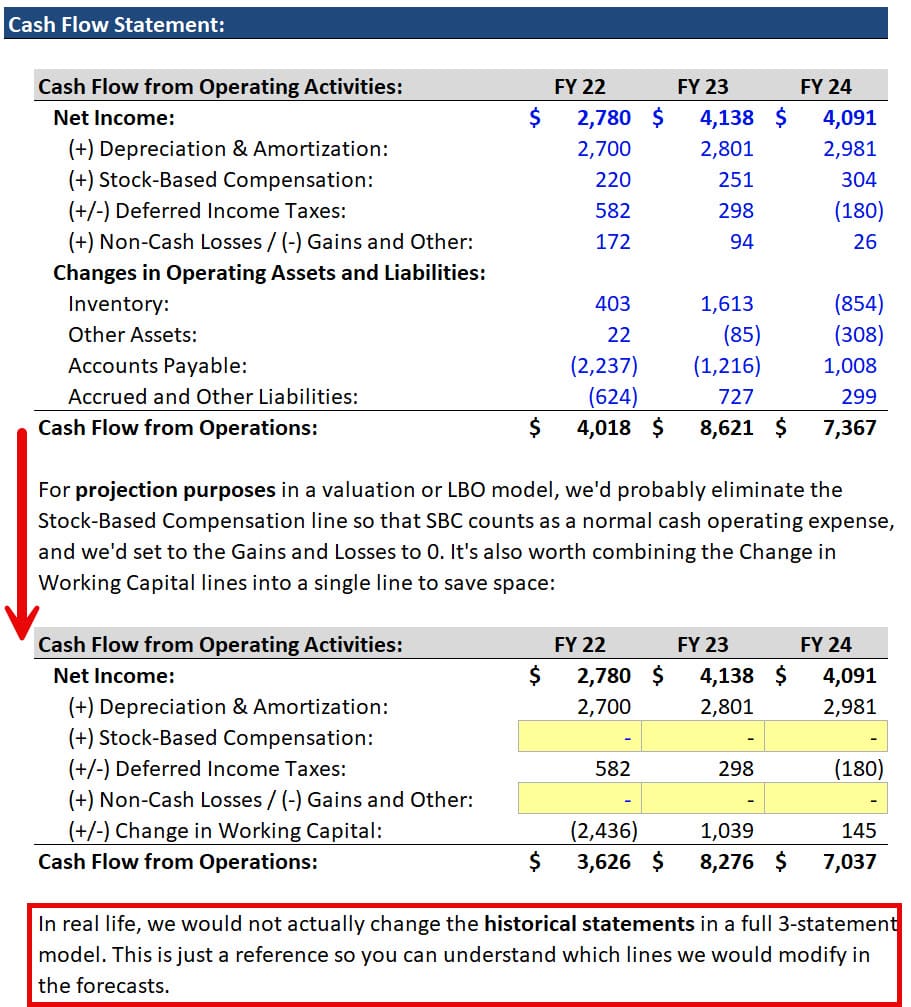
For U.S.-based companies that use the Indirect Method for the Cash Flow Statement, such as Target, the list of adjustments tends to be short:
Below are Target’s “baseline” Cash Flow from Operations section and our modified version.
Note that in real life, we would not “zero out” any items in the historical period; these are set to 0 here only to demonstrate what would happen in the projected period:
For a company like Watches of Switzerland that follows IFRS, it’s common to see “summary” Cash Flow Statements that start with a metric such as EBITDA or Adjusted EBITDA instead of Net Income.
The biggest problems here relate to the company’s classification of Net Interest Expense and CapEx, which we would change around in any forecast that requires Cash Flow from Operations and Free Cash Flow:
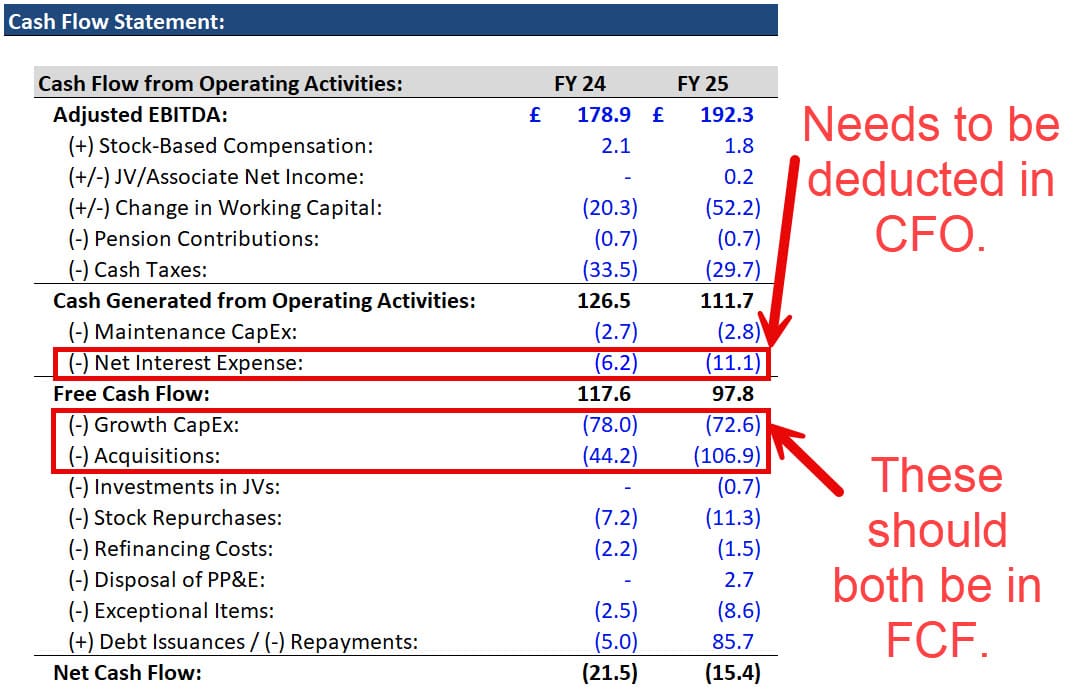
Our modified version looks like this:
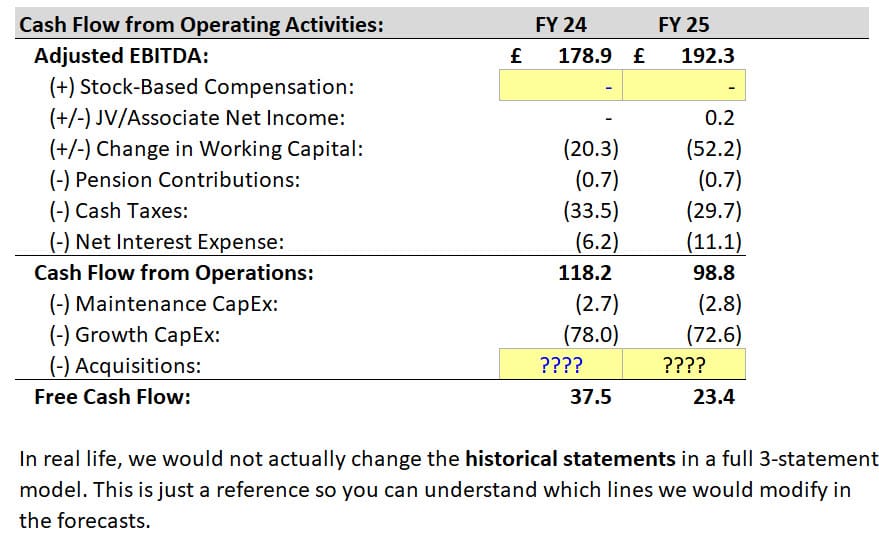
Moving to the last example, Telstra’s reported Cash Flow from Operations section (based on a reconciliation to the “Direct” version of its CFS) has several glaring issues:
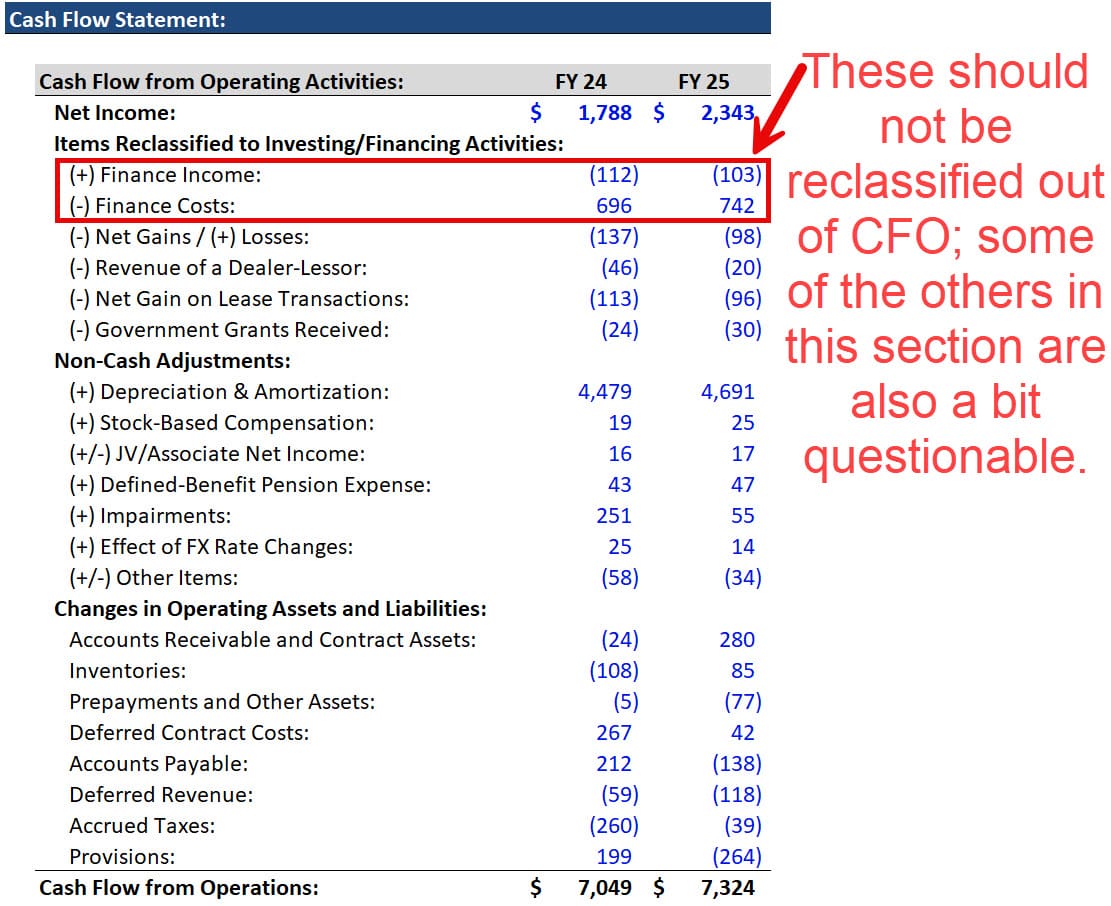
We would do the following to fix this:
Here’s the revised version:
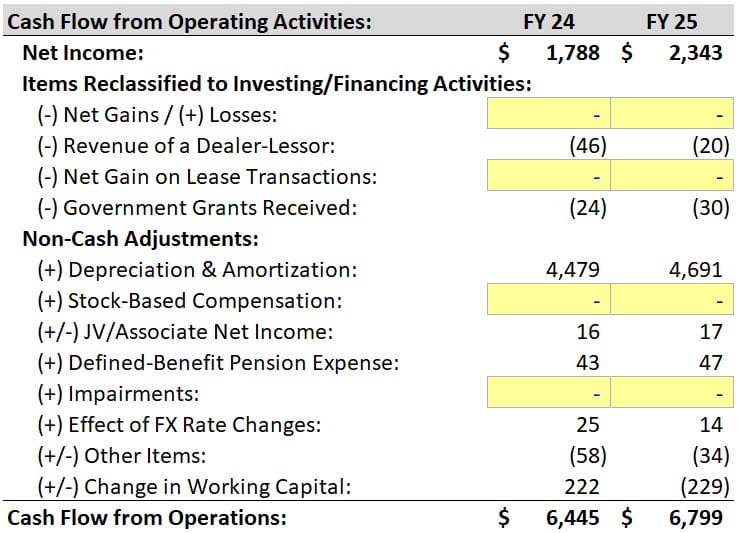
The time you spend on these adjustments depends heavily on the context.
For example, if it’s a 60-minute modeling test, you can’t afford to change much because that’s barely enough time to finish a real model.
But if it’s a 1-week test or an on-the-job task, you might spend hours making these changes.
Most metrics used in valuation multiples aim to do one of two things:
The problem is that Cash Flow from Operations does neither one well.
Effectively, it’s “the worst of both worlds” because it’s not that great for comparing companies due to the wide range of non-standard adjustments and line items in the historical periods…
…but it’s also not great for approximating the company’s cash flows to any investor group because it excludes major items like CapEx.
So, in valuation methodologies such as comparable public companies and precedent transactions, you tend to use metrics that are better suited for comparison purposes, such as EBIT and EBITDA.
And in cash flow-based methodologies, such as the DCF, you use metrics like Unlevered Free Cash Flow that better approximate the recurring cash flow.
All that said, you will sometimes see valuations based on multiples such as Equity Value / Cash Flow from Operations, also known as P / CFO when these are calculated on a per-share basis.
Here’s an example from the oil & gas industry in a Fairness Opinion for ConocoPhillips’ acquisition of Marathon Oil:

Have the bankers lost their minds and decided to use a non-ideal valuation metric?
It’s entirely possible that they have lost their minds after pulling 10 consecutive all-nighters, but the likely motivation is as follows:
For an Upstream oil & gas company, i.e., one that searches for oil and gas and drills wells to extract it, capital structure and taxes are very important.
These companies tend to use a lot of Debt, resulting in a high Interest Expense, and many use accelerated Depreciation and other deductions to reduce their Cash Taxes.
If the bankers used only EBITDA or EBITDAX, these metrics would not reflect the impact of these policies:

This raises the question of why they didn’t use Free Cash Flow to reflect CapEx fully, and we can’t answer that based on this document.
In Canada, many oil & gas companies use metrics such as “Adjusted Funds Flow from Operations” or “Funds Flow,” which are variations of Cash Flow from Operations.
Typically, they reverse the Change in Working Capital, Transaction Expenses, and the Decommissioning Expenditure required to retire oil/gas wells:

This metric, like CFO, also pairs with Equity Value in valuation multiples.
The logic is similar: Unlike EBITDA, this AFFO metric reflects the Net Interest Expense and Cash Taxes but not Capital Expenditures.
Therefore, it might be useful if you care about companies’ capital structures and tax policies but want to normalize or ignore their Capital Expenditures.
(Again, we question why they would not use Free Cash Flow to account for all of this and better approximate the true cash flow.)

Brian DeChesare is the Founder of Mergers & Inquisitions and Breaking Into Wall Street. In his spare time, he enjoys lifting weights, running, traveling, obsessively watching TV shows, and defeating Sauron.

